

 Meghan Oates-Zalesky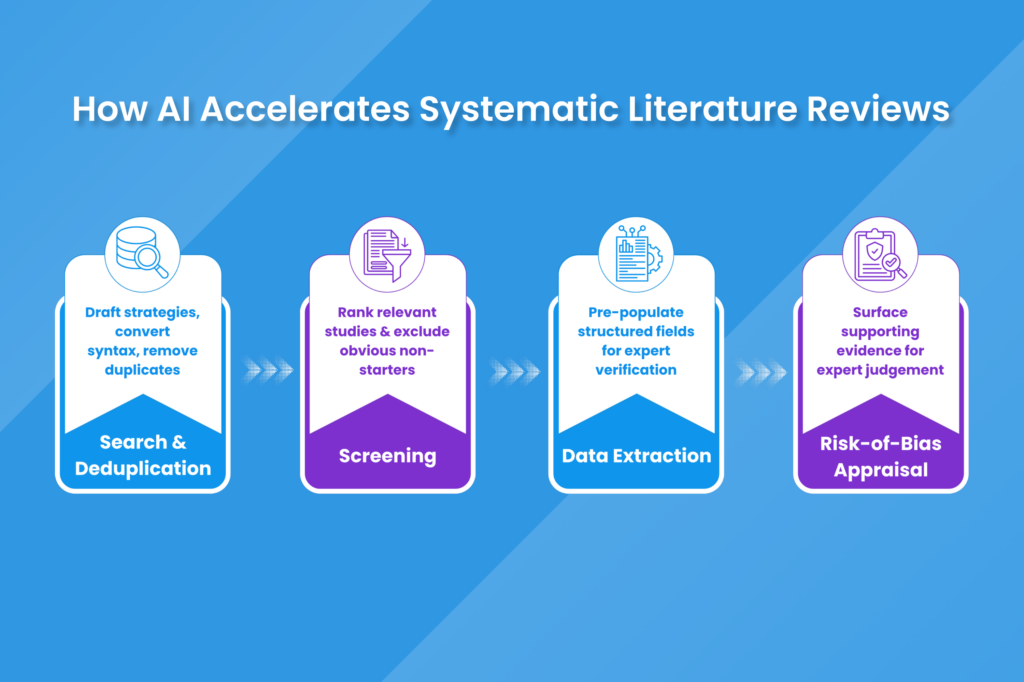
Why the Systematic Literature Review Timeline Still Runs Into Months
A typical systematic literature review (SLR) timeline is measured in quarters, not weeks, and the reason is rarely a lack of effort. Borah and colleagues tracked reviews registered on PROSPERO and found a median of 67.3 weeks from registration to publication (BMJ Open, 2017). As a result, by the time many reviews reach print, the newest trial in the evidence base is already two years old.
The delay is structural. A systematic review is exhaustive by design: you search every relevant database, screen everything you retrieve, have two reviewers assess studies independently, and document every decision to ensure the review process is transparent and reproducible. Consequently, effort scales with the volume you retrieve, not the volume you include. Broaden your search terms to protect sensitivity, and you may double the screening burden for a scant return in new evidence.
The frustrating part is not that the work is hard. Instead, it is that so much of the calendar goes to work nobody would call intellectual. Trained epidemiologists spend three months reading titles, roughly ninety-eight percent of which are irrelevant, to find the forty studies that matter. That is triage at scale: exactly what machine learning handles well. Therefore, a closer look at the SLR timeline shows that screening and extraction dominate the schedule. Because these tasks follow well-defined criteria and workflows, they are among the areas where AI can deliver the greatest efficiency gains.
How AI Accelerates Systematic Literature Reviews
 How AI Accelerates Systematic Literature Reviews
Search Building and Deduplication: Hours instead of Weeks
Translating a strategy across MEDLINE, Embase and Scopus is fiddly and error-prone. Tools such as MadeAi automate the syntax conversion, while automated deduplication resolves overlapping records. Meanwhile, language models draft the harder first step by turning a fuzzy question into a defensible Boolean string with MeSH terms and synonym clusters. The information specialist still owns the strategy; they simply start from a draft, not a blank page.
Screening: The Biggest Lever on Your Systematic Literature Review Timeline
This is where the months live. Two approaches now work reliably.
Active learning is the more mature approach. A reviewer screens a small seed set, the model learns from those decisions, and the remaining records are re-ranked so likely-relevant papers surface first. Because relevant records cluster near the top, the reviewer can stop well before the end of the list. Open-source active learning tools, benchmarked in Nature Machine Intelligence (van de Schoot et al., 2021), have demonstrated workload reductions of 83–92 percent while retaining 95 percent of relevant records.
LLM classification takes the direct route: you supply eligibility criteria in plain language, and the model judges each abstract. Recent evaluations report high sensitivity, often above 0.95, though precision varies by topic and degrades when criteria are ambiguous. Therefore, treat published figures as topic-specific rather than transferable. In practice, the strongest AI tools for literature review combine both: an LLM bulk-excludes the obvious non-starters, then active learning ranks what remains.
Data Extraction: From Transcription to Verification
Extraction inverts under AI. Instead of copying participant counts and effect sizes into a table, your reviewer verifies a pre-populated row. Evaluations of GPT-4-class models report accuracy in the mid-nineties for well-defined fields such as sample size and intervention type. Accuracy falls sharply, however, for anything interpretive, such as how outcomes were adjudicated, or what sits in a supplementary appendix. The posture is therefore unambiguous: the model drafts, the human signs off.
Risk-of-Bias Appraisal: A Supporting Role
RobotReviewer pioneered automated bias assessment by surfacing the sentences supporting each Cochrane domain, and newer LLM approaches extend this across frameworks. Even so, this stage compresses the least, and rightly so. Bias judgments get challenged in peer review, and they change conclusions. Automation locates evidence; it does not deliver the verdict.
Systematic Literature Review Timelines – the Numbers
| Stage | Traditional | AI-Assisted | Human Oversight |
|---|---|---|---|
| Protocol & registration | 4 weeks | 3 days | High |
| Search & deduplication | 3 weeks | 4 hours | Medium |
| Title/abstract screening | 12 weeks | 1–2 days | Medium (dual screening on borderlines) |
| Full-text review | 8 weeks | 3 days | High |
| Data extraction | 8 weeks | 2 days | High (verify all outcome data) |
| Risk-of-bias appraisal | 4 weeks | 1 day | Very high |
| Synthesis & write-up | 12 weeks | 4 days | Very high |
| Total | ~51 weeks | ~15 working days | Human validation throughout |
Crucially, this is not hypothetical. Clark and colleagues completed a full review in two weeks using automation tooling, logging roughly 61 person-hours (Journal of Clinical Epidemiology, 2020). Their conclusion was measured: standards held because experienced reviewers stayed in the loop at every decision point. If you are still mapping your own stages, our walkthrough of the systematic literature review process sets out what each one has to produce.
Where Speed Goes Wrong
A compressed systematic literature review timeline introduces failure modes that slow reviews never had.
- Missed studies you never learn about. A model with 95 percent recall misses one relevant paper in twenty, and a false negative leaves no trace. Validate against known relevant papers, set an explicit recall target, and citation-chase your included studies.
- Fabricated citations. Every reference must resolve to a real DOI. Verify programmatically, not by eye.
- Non-reproducibility. A hosted model updated in March will not reproduce February’s decisions. Log model versions, prompts, temperature, and stopping rules in your protocol.
- Automation bias. Reviewers who check pre-filled tables catch fewer errors than reviewers extracting from scratch. Build in blind spot-checks on a random sample.
On governance, the field has moved fast. The RAISE recommendations, Responsible use of AI in Evidence Synthesis, from Cochrane with JBI and the Campbell Collaboration set expectations for transparency, accountability and disclosure. Read them before you write your protocol, not after a reviewer asks. Choosing a validated AI platform for Life Sciences over an ad-hoc chatbot workflow matters here, because auditability is a product decision, not an afterthought.
From One-Off Review to Living Evidence
The obvious benefit is throughput. However, the more interesting one is that reviews become maintainable. When a review costs a year, it is a monument: published once, then slowly rendered obsolete. When it costs a fortnight, it becomes infrastructure. You can re-run the search quarterly, screen only new records, and update the synthesis, providing a living review that is finally practical outside well-funded groups. For example, during COVID-19, guideline committees needed exactly that and largely had to improvise.
Ultimately, the reviewers we work with do not describe this as automation replacing expertise. They describe reclaiming the part of the job that needed expertise. Nobody trained for six years to read 6,000 titles.
Author’s Note: This article was supported by AI-based research and writing, with Claude 4.6 assisting in the creation of text and images.