

 Meghan Oates-Zalesky
Consider a cross-functional team huddled around spreadsheets, regulatory guidelines, and past trial data, spending weeks or sometimes months crafting a single clinical trial protocol; see protocol structure details. Every inclusion criterion, endpoint, and safety measure must align perfectly with ICH-GCP standards, FDA expectations, and real-world feasibility. One misalignment, and you risk costly amendments, delayed starts, or even regulatory pushback. For decades, this has been the reality in clinical development.
However, as we move through 2026, agentic AI is shifting how protocols are created. Instead, these systems go beyond text generation; they can plan, reason, simulate, and iterate across the workflow. As a result, what once required hours of effort can now begin with a high-quality, regulation-aligned draft generated in minutes.
In fact, this shift is already underway. Leading pharma and technology organizations are deploying multi-agent platforms that translate high-level study objectives into structured, traceable protocol documents. These outputs include eligibility criteria, statistical analysis plans, risk assessments, and even simulated timelines.
The Pain Points of Traditional Protocol Generation
Developing a clinical trial protocol has always been a high-stakes balancing act. Sponsors, medical writers, biostatisticians, and regulatory experts must synthesize scientific literature, historical trial data, real-world evidence, and evolving guidelines—all while anticipating potential amendments that occur in nearly every study.
The result? Lengthy cycles, frequent revisions, and avoidable delays. Traditional methods often lead to 30-50% more protocol amendments than necessary, inflating costs and timelines.
Traditional vs. Agentic AI Protocol Generation
| Aspect | Traditional Approach | Agentic AI Approach (2026 Reality) |
|---|---|---|
| Time to First Draft | 160–220 hours (weeks to months) | Minutes to hours |
| Compliance Handling | Manual cross-checks against FDA/EMA rules | Real-time reasoning + embedded regulatory agents |
| Amendment Risk | High (30-50% of protocols amended) | Significantly reduced through simulation & foresight |
| Data Integration | Fragmented manual review | Multi-source orchestration (RWE, literature, past protocols) |
| Human Role | Heavy lifting on drafting & iteration | Strategic oversight, final review & creativity |
| Traceability | Manual audit trails | Automated, explainable logs for every decision |
How Agentic AI Drafts Compliant Protocols
Unlike traditional AI tools, agentic AI goes beyond simple generative tools. These systems act like a virtual team of specialists: one agent interprets the sponsor’s scientific objectives, another pulls relevant regulatory precedents and historical data, a third simulates enrolment feasibility and risk, and a fourth ensures ICH-GCP alignment while flagging potential deviations.
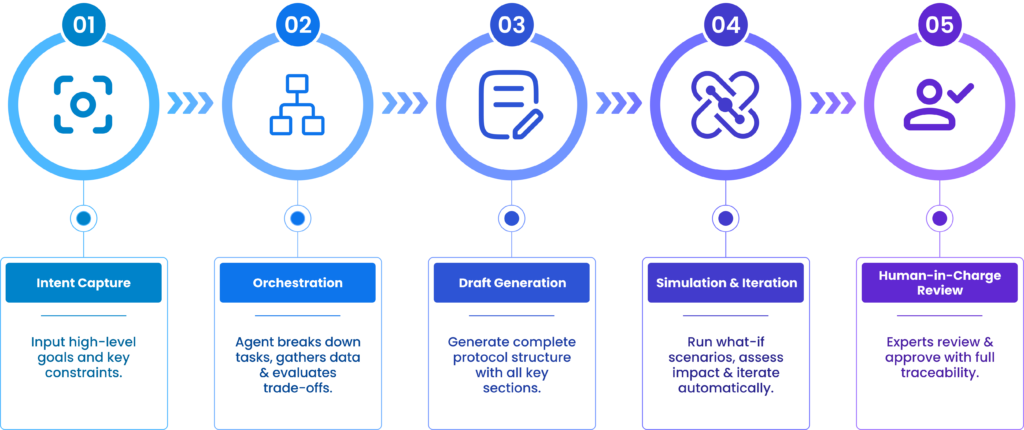 Agentic AI Protocol Workflow
Here’s the typical flow in action:
1. Intent Capture—You input high-level goals (e.g., “Phase II oncology trial targeting EGFR-mutated NSCLC with adaptive design”).
2. Orchestration—Autonomous agents break the task into subtasks, retrieve structured and unstructured data, and reason through trade-offs.
3. Draft Generation—The system produces a complete protocol structure, including objectives, endpoints, inclusion/exclusion criteria, visit schedules, statistical analysis plan, and risk-based monitoring strategy.
4. Simulation & Iteration—Built-in agents run “what-if” scenarios (e.g., impact of tightening criteria on recruitment speed) and iterate automatically.
5. Human-in-Charge Review—Final outputs include fully traceable rationales, providing clear justification for every decision. This ensures medical writers and regulators can verify, review, and confidently defend each inclusion criterion, while retaining ultimate authority over the outcome.
The Agentic AI Protocol Generation Lifecycle
Early pilots show strong results, with first drafts demonstrating high alignment to regulatory standards and consistent quality in downstream study builds. Accuracy levels have reached up to 90% in code and logic components in controlled evaluations, with clearly defined benchmarks and validation methodologies to ensure transparency and credibility.
Real-World Impact and 2026 Outlook
By the end of 2026, we expect:
- Preemptive protocol design that anticipates amendments before they happen.
- Seamless integration with Electronic Data Capture (EDC), Clinical Trial Management System (CTMS), and Electronic Trial Master File (eTMF) systems for end-to-end automation.
- Personalized, adaptive protocols that evolve with incoming real-world data.
These advances align perfectly with the FDA and EMA’s Guiding Principles of Good AI Practice in Drug Development (January 2026), which emphasize human-centric design, risk-based approaches, and transparent governance.
Key Takeaways
For Healthcare Leaders:
- Agentic AI can reduce protocol development time by 85-90% while improving quality.
- Implementation ROI is typically achieved within 2-4 weeks.
- Strategic repositioning of expert teams creates higher value.
Protocol Developers:
- AI handles routine drafting, freeing experts for strategic work.
- Quality metrics improve: fewer inconsistencies, better compliance.
- Job evolution: from document creation to design optimization.
Technology Teams:
- Multi-agent architecture enables complex reasoning tasks.
- Guardrails and validation layers ensure accuracy and compliance.
- Transferable framework applicable to adjacent domains.
Impact on the Healthcare Industry:
- Potential to accelerate 15,000+ protocols annually worldwide.
- $15-25B in value from faster time-to-market.
- Democratizes access to expert protocol development capabilities.
The Road Ahead
Agentic AI isn’t just speeding up protocol generation, it’s fundamentally changing how we design smarter, more patient-centric trials. What used to feel like an inevitable bottleneck is becoming a strategic advantage.
The question for clinical development leaders isn’t whether this technology will reshape your workflows. It’s how quickly you’ll harness it to bring better medicines to patients sooner.
Conclusion
The clinical trial protocol that took three weeks to write now takes a few minutes to draft and two/three days to refine. The recovered weeks let the team start a trial treating a rare pediatric disease six months earlier than originally planned. Somewhere, a child received a potentially life-saving treatment sooner because an AI system handled routine protocol drafting efficiently.
The protocol development bottleneck that frustrated researchers for decades is dissolving. The implications extend far beyond faster document creation. As a result, when we remove artificial constraints on how quickly we can transform ideas into action, we accelerate the entire innovation cycle. In healthcare, that acceleration translates directly into lives improved and saved.
Author’s Note: This article was supported by AI-based research and writing, with Claude 4.6 assisting in the creation of text and images.