

 Meghan Oates-Zalesky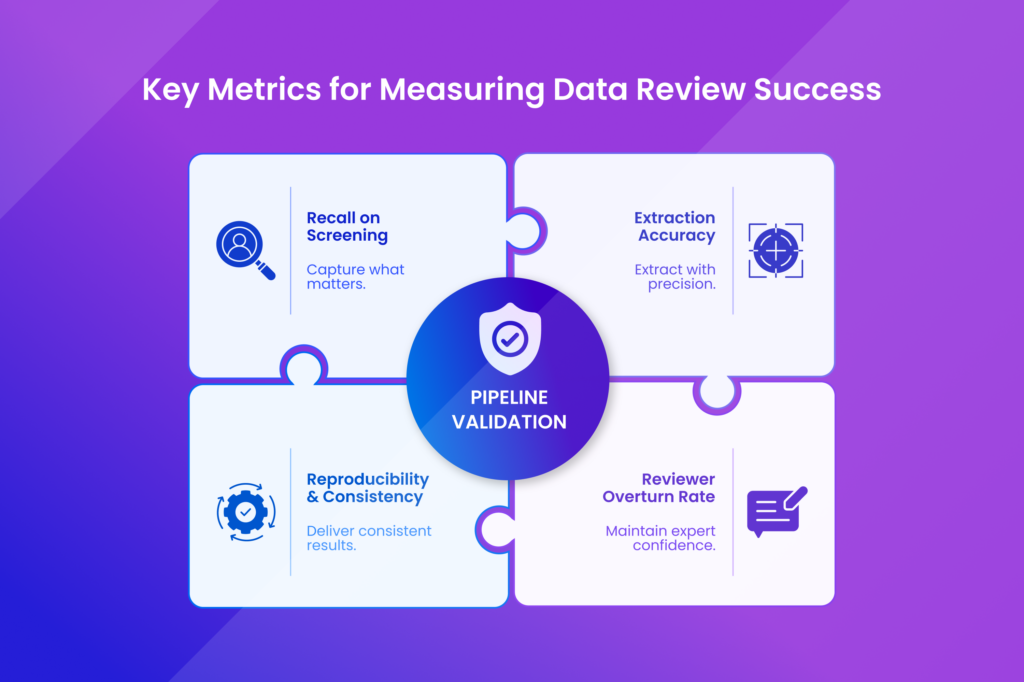
Background: Scientific Data Review
Evidence volumes are rising, but review teams are not. In 2010, the scientific community published roughly 75 trials and 11 systematic reviews daily, and this pace has only accelerated. Today, more than 200 new systematic review protocols are registered in PROSPERO every day, illustrating how demand for evidence synthesis has outpaced the capacity of traditional review workflows. Consequently, the true bottleneck in deep tech and research is no longer data storage, but human attention.
When organizations attempt to scale scientific data review by simply hiring more people or working longer hours, they quickly hit a ceiling. To truly manage this data deluge, we must redesign pipelines so that automation handles routine tasks, allowing human experts to focus purely on scientific judgment.
Why Traditional Manual Review Stalls
Manual review fails because workload growth outpaces human capacity. For instance, a single systematic review can take more than a year to publish and cost approximately $141,000. When faced with rising data volumes, organizations typically try three familiar responses, but each one eventually stalls:
Adding reviewers: Costs scale linearly, onboarding takes weeks, and inter-reviewer consistency drops.
Narrowing the search: This immediately reduces volume but raises the risk of missing eligible studies, which teams must later defend to journals or regulatory bodies.
Buying basic screening tools: This speeds up early steps, but the bottleneck simply shifts downstream, leaving data extraction and quality checks entirely manual.
Ultimately, these approaches fail because they treat data review as one undifferentiated task.
Separating Volume Work from Judgment Work
To enable evidence synthesis at scale, we must split scientific workflows into two distinct lanes: “Volume Work” and “Judgment Work”.
Volume work relies on consistency and repetition. This includes deduplication, field normalization, language handling, and pulling candidate values from results tables. AI solutions for life sciences apply the same level of accuracy and consistency to record 40 as they do to record 9,000.
By contrast, judgment work requires deep interpretation and accountability. This includes framing the research question, defining eligibility criteria, ruling on ambiguous abstracts, and signing off on clinical interpretations. This work belongs exclusively to human experts.
Therefore, the core engineering goal is straightforward: send as little data as possible into the human lane, ensuring everything that arrives there truly requires a reviewer’s attention.
Core Architecture for Scientific Data Review

AI-Powered Literature Review Pipeline
Building AI tools for literature review requires layering automated processing with strategic human oversight. A production-ready pipeline typically follows these steps:
Ingest and Normalize: Deduplication and field mapping must happen upstream upon initial ingestion. As a result, human reviewers receive one clean, unified record per study rather than fragmented partial records.
Rank by Relevance: Using prioritized screening, machine learning classifiers rank records so the most relevant studies sit at the top of the queue. Research shows this can reduce workloads by 30 to 70 percent while successfully retaining high recall.
ML-Assisted Extraction: Large language models draft candidate annotations and extract data fields. This significantly reduces the volume of text that experts must read from scratch.
Human-in-Charge Review: Automation escalates uncertain cases rather than finalizing them. Human reviewers step in to adjudicate borderline records and verify sampled data fields, continuously training the AI models with their corrections.
Five Principles for Scaling Scientific Data Review
To ensure your automated pipeline holds up under intense regulatory audit, you must build it on five foundational principles:
1. Normalize at ingest, not at review: Solve formatting chaos and duplicate records before they ever reach human reviewers.
2. Rank before anyone reads: Surface the most likely eligible records first, letting the system learn dynamically from every human decision.
3. Define a stopping rule before you start: Agree on the mathematical target recall and statistical sampling method required to safely stop screening.
4. Keep humans at checkpoints: Let machines route clear inclusions and exclusions automatically, saving human intervention for complex edge cases.
5. Record everything, by default: Capture the exact search string, tool version, and timestamp for every decision. Traceability in evidence synthesis is exactly what turns an efficient process into a legally defensible one.
Measuring Data Review Success Without Sacrificing Rigor
In deep tech, efficiency claims mean nothing without empirical validation. Treat your AI pipeline like any other scientific method and measure it rigorously. Success in these systems is defined by improving throughput and fidelity simultaneously.

Key Metrics for Measuring Data Review Success
Key metrics to monitor include:
- Recall on Screening: Run dual independent screening on a random sample of data and compare it against the pipeline’s decisions. The agreement must be high enough that missed inclusions are rare exceptions, and every miss is actively investigated.
- Extraction Accuracy: Compare the AI’s field-level extraction against a human-curated gold standard subset, tracing errors back to their root algorithms rather than just tallying them.
- Reproducibility and Consistency: Re-run identical queries after system updates to ensure differences can be explicitly explained and documented.
- Reviewer Overturn Rates: Track how often human experts override the AI’s suggestions. A stable, explainable overturn rate strongly indicates a well-calibrated machine learning model.
When architected correctly, the real-world results are profound. Advanced AI Solutions for Life Sciences demonstrate that teams can complete evidence synthesis work roughly 60 percent faster, achieving 50 to 60 percent cost savings, all while maintaining greater than 90 percent accuracy and 96 percent traceability. Customer and researcher satisfaction remains exceptionally high because experts are finally spending their valuable hours doing what they were trained to do.
The Regulatory Requirements: These workflow optimizations are not just operational conveniences; they are rapidly becoming compliance necessities. Under frameworks such as Regulation (EU) 2021/2282, Joint Clinical Assessments for new oncology and advanced therapy medicines demand exhaustive completeness and transparency. Health Technology Assessment (HTA) bodies like NICE and IQWiG are not opposed to AI and efficiency; they are opposed to opacity. By building rigorous provenance tracking into the pipeline from day one, the evidence of your AI’s performance becomes a compelling part of your regulatory submission narrative, rather than a glaring methodological gap.
Looking Ahead: The Future of Scientific Discovery
The era of scaling manual review linearly with data growth is over. The literature and data streams will continue to grow exponentially; realistically, your expert review teams will not. The research organizations that will dominate the next decade are the ones that stop asking their smartest people to read everything, and start engineering software to decide what actually deserves to be read.
The next generation of deep tech systems will move even further, treating data readiness itself as a reusable community asset. In addition, we will see the rise of shared, provenance-rich pipelines and agentic AI orchestration constrained by specialized, domain-specific skill libraries. The barrier to entry will continue to lower as open-source workflow managers and pre-trained foundation models allow even small research groups to leverage institutional HPC resources.
Finally, by embracing automated preprocessing, ML-assisted extraction, and selective human oversight, we can fundamentally break the manual bottleneck. We can keep pace with the data deluge while preserving the uncompromising quality, rigor, and accountability that true scientific discovery demands.
Author’s Note: This article was supported by AI-based research and writing, with Claude 4.5 assisting in the creation of text and images.