

 Meghan Oates-Zalesky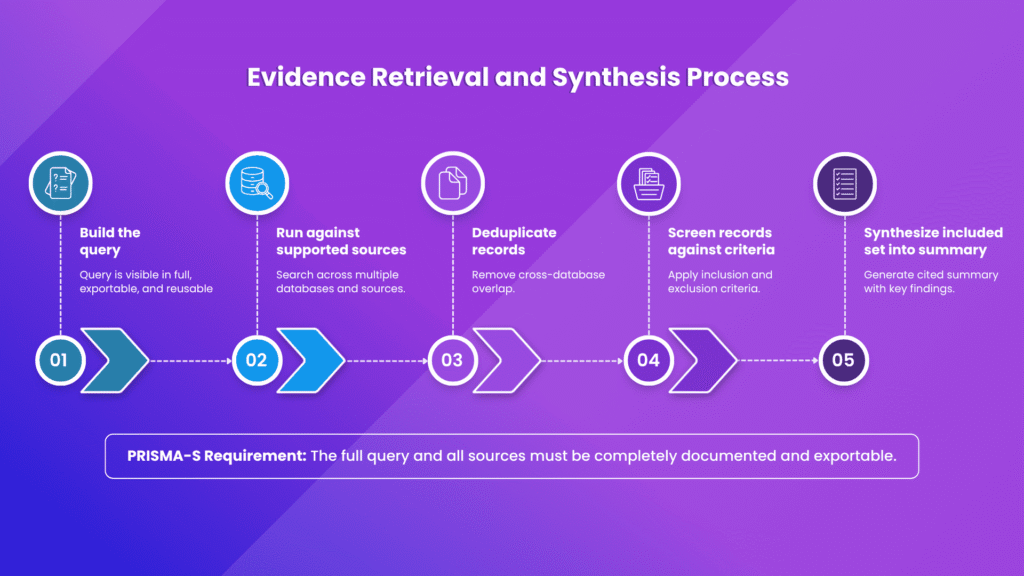
Overview
A conversational AI literature review changes where the hardest translation in evidence synthesis happens: the move from a clinical question to a database query a reviewer must defend. Evidence teams in life sciences rarely fail for lack of information. They fail because the volume of information has outgrown the methods used to search it.
A market access lead, a medical affairs director, and a health economist all hit the same wall. Each must convert a clinical question into rigid database syntax, then defend that translation to reviewers who judge the whole body of work by the quality of the search.
Conversational systems move that translation into a dialogue. The system clarifies the objective and drafts the query, while the researcher keeps every decision that matters: scope, eligibility, and interpretation.
The Evidence Challenges in Life Sciences
Evidence Challenges in Life Sciences
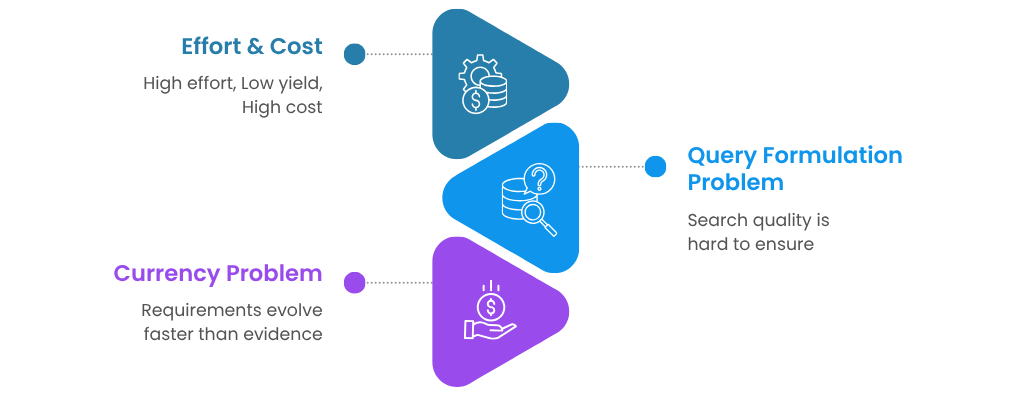
Effort and Cost
Borah and colleagues analyzed 195 completed reviews registered in PROSPERO and reported in BMJ Open a mean of 67.3 weeks from registration to publication. Searches returned between 27 and 92,020 records at a mean yield rate of 2.94 percent, so reviewers spend most of their screening effort confirming that records are irrelevant. Michelson and Reuter separately estimated a single review at roughly $141,195. Our breakdown of the systematic literature review timeline shows where those weeks go.
The Query Formulation Problem
Search quality is the largest determinant of review validity. However, it is also the least reproducible step. Sampson and McGowan catalogued recurring search errors in the Journal of Clinical Epidemiology: missed spelling variants, incorrect Boolean operators, unwarranted truncation. PRISMA-S answered with a 16-item checklist, and it exists precisely because search reporting had proven unreliable. Yet a reporting standard improves transparency after the fact; it does not reduce the effort needed to build a defensible query.
The Currency Problem
The European Union’s HTA Regulation introduced Joint Clinical Assessments from 12 January 2025, for new oncology medicines and advanced therapies. The scope expands to high-risk devices in 2026, orphan medicines from 2028, and all new medicinal products from 2030. Each expansion enlarges the number of dossiers needing a current, fully documented evidence base inside a fixed window.
What Conversational Evidence Search Actually Changes
Conversational evidence search is not a chatbot in front of a database. It is a structured workflow where dialogue is the interface for question refinement, while every downstream step stays deterministic, logged, and reviewable.
A model answering from its training weights is fundamentally different from one that retrieves records from a live index before generating text. That design derives from retrieval-augmented generation, described by Lewis and colleagues at NeurIPS 2020, which pairs a parametric model with a non-parametric index so output stays grounded in retrieved documents rather than recalled from memory.
Three changes follow. First, the researcher asks in clinical language. Second, the structured question, criteria, and query become inspectable artifacts before retrieval runs. Finally, every statement links to its supporting record, so a reviewer audits the claim rather than trusting the tool.
How the Workflow Operates
Evidence Retrieval and Synthesis Process
Dialogue and Structured Question Formulation
The researcher describes the problem in clinical language, and the system asks clarifying questions to resolve ambiguity in population, comparator, and outcome. It then converts the objective into a formal framework, typically PI(E)COS. This is the critical control point: the structured question determines the criteria, and the criteria determine the query, so it must be presented for approval and remain editable.
Query, Retrieval, and Screening
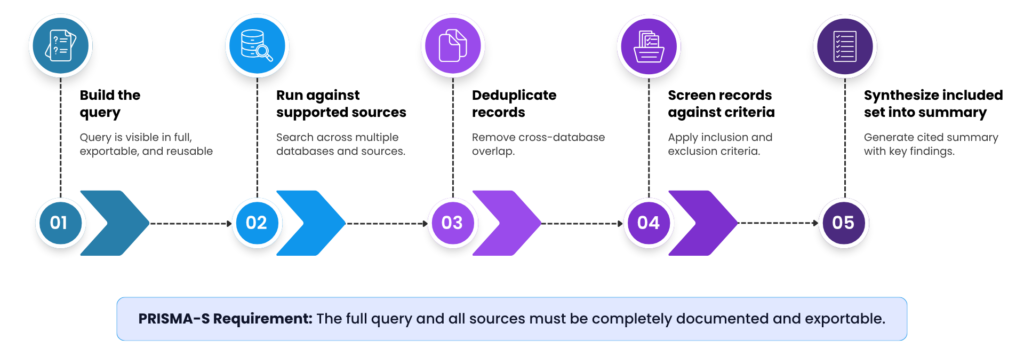
The system then builds the query and runs it against supported sources. That query must be visible in full, exportable, and reusable, since PRISMA-S expects complete documentation for every source searched. Deduplication removes cross-database overlap; records are screened against the criteria, and the included set is synthesized into a cited summary.
Traceability and Handoff
Each assertion should link to a record identifier such as a PubMed ID. The session then hands off into a full review project, carrying the objective, query, and criteria forward, which is where structured literature review services pick up without rekeying.
Comparing Traditional and Conversational Approaches
| Dimension | Traditional Manual Review | Conversational Evidence Search |
|---|---|---|
| Question formulation | Manual; needs a methodologist | Dialogue-driven; drafted for approval |
| Query construction | Hand-built per database | System-generated, editable, shown in full |
| Traceability | Depends on team discipline | Assertion-level links, exportable query |
| Principal risk | Search error, irreproducibility | Over-trust in unverified fluent output |
Conversational systems replace neither methodological expertise nor dual human review in a formal systematic review. They shorten the distance between a clinical question and a defensible starting point.
Benefits and Use Cases
Scoping traditionally consumes weeks of methodologist availability. A conversational AI literature review produces a structured question, draft criteria, and an executable query in one session. For example, HEOR teams can scope comparative effectiveness before committing to a protocol. Additionally, market access teams can identify evidence gaps before dossier assembly. Because the objective and criteria persist, refreshing a review becomes a repeat execution rather than a reconstruction, which reserves specialist attention for the reviews that need it, in-house or through external Systematic literature review services.
Best Practices for Governed Deployment
Cochrane, the Campbell Collaboration, JBI, and the Collaboration for Environmental Evidence published a joint position statement on AI in evidence synthesis in 2025, aligned to the RAISE recommendations: synthesists remain accountable, rigor must not be compromised, oversight is required, and any AI use that makes or suggests judgments must be reported.
- Define which review types the system may support and which require dual human screening.
- Validate against a completed internal review for a recall estimate on your own domain.
- Treat the generated query as a draft that an information specialist edits and documents.
- Have a human confirm every exclusion in any review intended for submission.
- Verify that each cited record exists, resolves, and supports the claim attributed to it.
- Export the session, query, criteria, and source list so the work can be reconstructed.
Limitations
What a Conversational AI Literature Review Cannot Do
Clark and colleagues reviewed 19 comparative studies in Research Synthesis Methods and found generative AI missed 68 to 96 percent of relevant studies, a median of 91 percent, when used for searching. They concluded that current evidence does not support use without human involvement. Conversational search therefore supports scoping and prioritization; it does not replace a specialist-built search where completeness is the standard.
Citation fabrication is the second failure mode. Walters and Wilder reported in Scientific Reports that 55 percent of GPT-3.5 and 18 percent of GPT-4 citations were fabricated. Retrieval grounding reduces this, but verification stays mandatory. Coverage limits persist too: a PubMed-only system misses conference abstracts, regulatory documents, and registry entries that HTA bodies expect to see searched.
Conclusion
A conversational AI literature review addresses a specific failure point. Translating a clinical question into a database query has always demanded specialist skill, frequently introduced error, and rarely been reported reproducibly. A retrieval-grounded workflow makes that translation inspectable and auditable. Our analysis of the future of systematic literature reviews examines where that assisted model breaks.
The practical next step is narrow. Take one completed review from your portfolio, run the same question through a conversational workflow, and compare the retrieved set, generated query, and draft synthesis against what your team produced manually. That tells you more than any evaluation matrix.
MadeAi builds conversational research capability for life sciences evidence teams, with source-linked summaries, exportable queries, and structured handoff into full review projects. Teams comparing AI Solutions for Life Sciences can run that validation independently or with our evidence methodology group.
Author’s Note: This article was supported by AI-based research and writing, with Claude 5 assisting in the creation of text and images.