

 Meghan Oates-Zalesky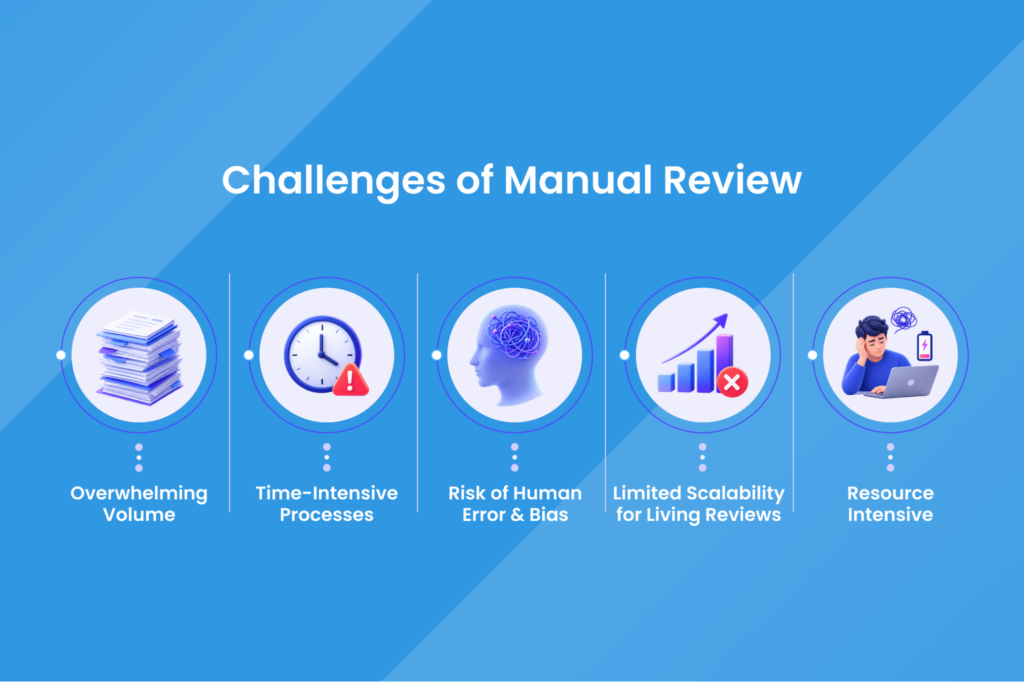
Overview
The future of Systematic Literature Reviews (SLRs) depends on thoughtful integration of technology rather than complete replacement of expert judgment. SLRs remain the foundation for reliable evidence synthesis across healthcare, technology assessment, and policy. The volume of published studies continues to grow. As a result, research teams face increasing pressure to deliver timely, transparent, and reproducible results.
Artificial intelligence has entered the Life Sciences domain with clear potential to ease mechanical tasks such as prioritization and structured extraction. However, validation studies and scoping reviews show that full automation carries significant risks. These include missed evidence, undetected bias, and opaque reasoning. The durable direction is therefore AI-assisted workflows that keep trained reviewers in control of every critical decision. This perspective draws on current performance data and the capabilities of practical tools. It also connects to related discussions on how AI is revolutionizing systematic research and the core systematic literature review process.
Challenges and the Limits of Manual Review
Research output in the life sciences grows by millions of records each year. Living guidelines, health technology assessments (HTAs), and rapid evidence needs leave little room for multi-year review cycles. Dual independent screening of thousands of titles and abstracts remains time-intensive. Data extraction and risk-of-bias appraisal require nuanced methodological judgment that pure pattern matching frequently misses.

Challenges of Manual Review
Organizations responsible for guidelines and reimbursement decisions have long recognized this pressure. Early automation focused on classical machine learning for ranking records. Generative models later expanded experimentation to search support, draft extraction, and preliminary synthesis. Independent evaluations confirm efficiency gains on routine steps while underscoring the continued necessity of human oversight. Teams exploring literature review services for life sciences therefore face a practical choice: capture speed without compromising the trustworthiness that defines high-quality evidence synthesis.
What Good AI-Assisted Evidence Synthesis Actually Looks Like
These limitations do not argue against using AI in systematic reviews. Instead, they highlight the need to calibrate trust by task. Screening and data extraction are among the strongest use cases, where AI can handle more of the workload while human reviewers focus on verification and targeted quality checks.
More interpretive tasks require greater oversight. AI-generated risk-of-bias assessments should serve as structured first drafts that qualified reviewers verify against the source evidence. Requiring every AI-generated judgment to cite the supporting passage can make this verification faster and more transparent.
Human review should also extend to the final interpretation and conclusions, not just individual data points. The most effective approach is therefore not AI versus human review, but a task-specific model that applies automation where evidence supports it and preserves human judgment where uncertainty remains.
Technical Foundations of AI Assistance
Modern support rests on several complementary techniques. Active learning classifiers re-rank remaining records after a human labels a modest training set, so likely relevant studies surface earlier. This approach can reduce screening workload substantially while preserving high recall.
Large language models, when paired with retrieval-augmented generation or carefully engineered prompts, can propose PICO structures, draft inclusion rationales, extract structured fields that cite source text, and surface candidate risk-of-bias judgments. Specialized multi-agent systems assign distinct modules to search, screening, preprocessing, extraction, and reporting, always under structured human review.
Semantic search moves beyond pure keywords. Tools that index large corpora return ranked papers with summaries. Citation-context systems further indicate whether a paper supports, challenges, or merely mentions a claim. Newer models achieve high median agreement on title-and-abstract screening. Results become more variable on complex extraction and risk-of-bias tasks that demand domain expertise. Human–AI collaboration improves efficiency when uncertainty is deferred to experts, though complementarity is not automatic on every decision task.
Workflow for the Future of Systematic Literature Reviews
A reliable AI-assisted pipeline follows these stages with explicit human control points:
1. Protocol development and search strategy design stay primarily human. AI may suggest synonyms or Boolean refinements that experts then validate.
2. Record import, deduplication, and prioritization use machine-learning ranking or model-assisted filtering. Humans review high-priority and borderline cases.
3. Title/abstract and full-text screening operate under dual-review or prioritized single-review-plus-audit models. Disagreements trigger human resolution.
4. Data extraction begins with model-generated tables that cite source sentences. Reviewers verify every critical field.
5. Risk-of-bias assessment uses model suggestions as a first pass; final domain judgments remain with trained reviewers.
6. Synthesis, interpretation, and report writing stay human-led. Models may draft sections or generate flow diagrams, but authors own the narrative and conclusions.
Benefits Observed in Practice
When teams apply disciplined oversight, assistance delivers concrete gains. Evaluations of prioritization tools commonly report workload reductions of 50% or more at high recall. However, results vary by topic and stopping rule. Living systematic reviews become more practical because continuous prioritization lowers the cost of updates. Broader questions or larger corpora become feasible without proportional increases in headcount.

Results of AI-Assisted SLR
Routine extraction fields often show lower error rates once humans correct systematic model mistakes and feed those corrections back into prompts. Use cases span health economics, clinical guideline development, and technology assessment. Platforms offering AI-Based Evidence Synthesis Tools illustrate how these capabilities can be packaged for research teams while still requiring verification at every stage.
Comparison of Review Approaches
| Aspect | Traditional Manual | AI-Assisted (Human-in-Charge) | Fully Automated |
|---|---|---|---|
| Screening speed | Linear with volume | Prioritization cuts workload substantially | Fast but risk of missed studies |
| Accuracy on complex criteria | High with dual review | High when humans resolve uncertainty | Variable; lower on nuanced judgment |
| Transparency | High if well documented | High if tool versions, prompts, and audits reported | Often limited |
| Suitability for living reviews | Costly to maintain | Feasible | Attractive in theory, fragile in practice |
| Risk of bias introduction | Human fatigue and inconsistency | Model bias + residual human error (manageable) | Compounding model errors and hallucinations |
| Editorial acceptance | Established | Growing with proper disclosure | Generally not accepted for high-stakes work |
Best Practices That Protect Quality
- Register the protocol and pre-specify any AI components, including thresholds and verification plans.
- Select tools with documented performance on similar domains and transparent methods.
- Treat every model output as draft material that requires verification.
- Measure human-AI agreement on a calibration set before scaling.
- Maintain dual independent review for critical inclusion decisions until local validation justifies otherwise.
- Disclose tool names, versions, configurations, and the exact human oversight process.
- Prefer citation-grounded or retrieval-augmented systems when factual accuracy matters.
- Re-evaluate newer model generations; performance improves, yet so do the requirements for re-validation.
- Monitor override rates; near-zero rates can signal automation bias and should be investigated.
Organizations working at the intersection of AI in Life Science can apply these practices directly to evidence synthesis projects.
Risks and Why Full Automation Remains Unready
AI performance in evidence synthesis remains highly task-dependent. Screening currently demonstrates the strongest and most consistent results, while more complex activities such as detailed data extraction, risk-of-bias assessment, and interpretive synthesis show greater variability. Challenges including hallucinations, fabricated references, subtle shifts in meaning, and sensitivity to prompt wording can affect the reliability of outputs. Biases within training data may also lead to under-representation of certain populations or study designs. These risks can become more significant when errors compound across sequential automated steps. In addition, limited transparency around the training data and development of many AI systems can make reproducibility and independent validation more difficult.
Independent scoping reviews conclude that applications are rising rapidly yet remain “not yet ready for use” without substantial human involvement. Fully automated end-to-end pipelines stay experimental and unsuitable for decisions that affect patients or policy. Over-reliance also risks deskilling reviewers who no longer practice the close reading that builds deep domain understanding.
Future Trends and the Role of Generative AI in Life Sciences
Near-term progress will focus on tighter collaboration interfaces, better explainability through source-span highlighting, multimodal handling of figures and tables, and standardized evaluation benchmarks. Agentic systems that orchestrate specialized modules under continuous human supervision are already appearing in research prototypes. Reporting standards continue to evolve with explicit items for AI-assisted steps.
Living reviews will benefit most as continuous ingestion and prioritization become routine. Longer term, the boundary between assisted and more autonomous systems may shift for narrowly scoped, well-validated tasks. The core principle is unlikely to change: evidence synthesis that informs high-stakes decisions requires accountable human judgment. Advances in Generative AI Life Sciences will continue to expand capacity, yet the decisive factor remains how teams design the human control points around those advances.
Conclusion
The future of SLRs is collaborative. AI tools already reduce the mechanical burden of volume and repetition, freeing experts to concentrate on critical appraisal, contextual interpretation, and synthesis. Full automation still introduces unacceptable risks of missed evidence, undetected bias, and opaque reasoning. Teams that adopt assisted workflows with clear protocols, rigorous verification, and transparent reporting will produce faster, more current, and still trustworthy reviews.
In contrast, complete automation without appropriate safeguards can undermine the credibility of systematic reviews. Start by auditing one stage of the next review (screening prioritization or structured extraction), measure actual time and quality impact under human oversight, and iterate from there. Measured, human-centered adoption remains the evidence-supported path. Organizations seeking practical support can explore resources from MadeAi while maintaining the same standards of verification and disclosure described above.
Author’s Note: This article was supported by AI-based research and writing, with Claude 5 assisting in the creation of text and images.