

 Meghan Oates-Zalesky
Overview
AI vs. traditional systematic literature reviews (SLRs) is a question evidence teams now face daily, not just in academic debate. An SLR is a structured process for reviewing available research on a defined question. It includes identifying, screening, appraising, and synthesizing relevant studies. It follows a pre-registered protocol, such as the one described in the PRISMA 2020 statement. Traditional SLRs rely on manual screening and extraction. AI-assisted reviews use machine learning and language models to speed up specific stages, without replacing the underlying methodology. The question that matters is where each approach fits.
Challenges of Traditional Systematic Literature Reviews
Cochrane’s methodological guidance sets the typical systematic review at 18 months of active work. At the same time, biomedical publication volume grows faster than review teams can screen it by hand. This gap shows up in scientific data review work, where regulatory and reimbursement decisions depend on current evidence. Manual screening, dual-reviewer reconciliation, and risk-of-bias assessment are rigorous, but they are also labor-intensive, and delays compound across large review programs. Fast-moving therapeutic areas like oncology and rare disease feel this pressure first.
How AI Changes the Systematic Review Workflow
AI does not remove the SLR methodology. It changes which parts of that methodology demand full-time human attention. Tools such as ASReview, developed at Utrecht University, use active learning to rank titles and abstracts by relevance. As a result, reviewers see the most likely relevant records first instead of working through an unordered list. A 2024 analysis published in the journal Systematic Reviews found that AI-enhanced tools reduce manual workload by 50% to 75% across screening, extraction, and risk-of-bias assessment. The analysis found that these workflows can preserve PRISMA-grade rigor when a human reviewer stays in the loop.
AI-Assisted vs. Traditional SLR: A Stage-By-Stage Look
- Search strategy. Traditional reviews depend on manually built Boolean strings. AI tools for literature review suggest and refine search terms based on semantic relevance, not just keyword matching.
- Screening. Traditional dual-screening is exhaustive but slow. Active-learning models prioritize likely-relevant records for human sign-off.
- Extraction. Traditional extraction is manual and prone to error under time pressure. AI extraction tools pull structured data into templates for reviewer verification.
- Quality appraisal. Both approaches require trained reviewers applying tools like RoB 2. AI flags inconsistencies for a second look, but it does not make the final call.
Traditional vs. AI-Assisted Systematic Reviews
The comparison shows that AI-assisted SLRs primarily improve the speed and consistency of mechanical review tasks while keeping human judgment central to consequential decisions. However, traditional SLRs are constrained by reviewer capacity, which can limit screening throughput and introduce fatigue-related variation during extraction. Human-directed AI workflows can prioritize large volumes of records, perform first-pass classification, and support structured data extraction. For example, in validated pipelines, screening sensitivity has reached up to 96.7%, compared with 81.7% for human screening, although performance depends on the specific workflow and dataset.
| Dimension | Traditional SLR | AI-Assisted SLR (Human-Directed) |
|---|---|---|
| Screening throughput | Limited by reviewer hours | High-volume prioritization and first-pass classification |
| Sensitivity (reported) | Variable; dual review mitigates misses | Up to 96.7% in validated pipelines vs. 81.7% human |
| Extraction consistency | Subject to fatigue and variation | Higher measured accuracy in structured fields |
| Risk-of-bias judgment | Fully human | AI drafts with evidence; human verifies |
| Audit trail | Manual reconstruction | Evidence-bound and timestamped by design |
| Timeline | Months to more than a year | Days to weeks for mechanical stages |
| Primary residual risk | Incomplete coverage under time pressure | Cascading errors if human gates are weak |
Implementation Best Practices for Life Sciences Teams
Life sciences organizations that treat AI vs. traditional SLRs as a hybrid model, rather than a binary choice, get better results. Three principles drive that outcome. First, pre-register the protocol and define inclusion criteria before any AI tool touches the corpus, so automation supports the plan instead of shaping it. Second, keep a qualified reviewer as the final decision-maker on inclusion, exclusion, and bias ratings; AI narrows the field, but judgment calls stay human. Third, document AI use transparently. Major publishers, including Cochrane, BMJ, and The Lancet, require disclosure of AI-assisted stages under the PRISMA-trAIce checklist referenced in JMIR AI’s 2025 guidance.
Teams evaluating SLR services should ask vendors how audit trails are maintained, and whether extraction outputs map back to source PDFs for traceability. This matters most in an evidence generation strategy that accounts for rare-condition datasets, where source volume is thin, and every record carries more weight. This challenge is covered in more depth in this analysis of evidence for rare disease research.
Risks and Limitations to Manage
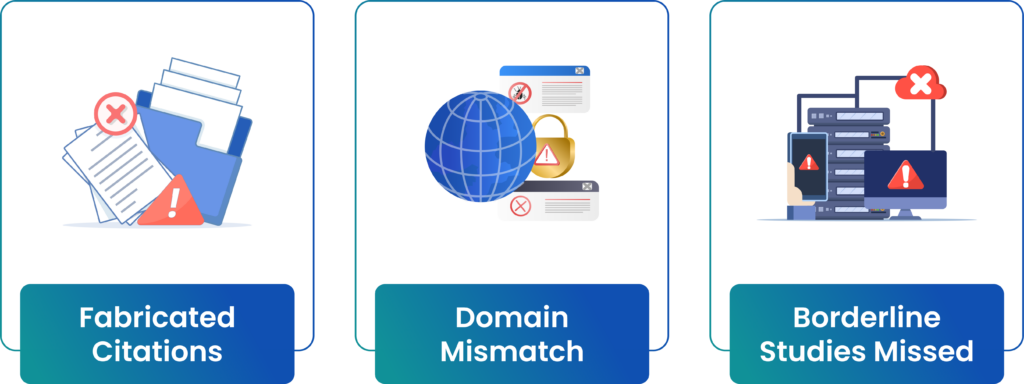
Key Risks in AI-Assisted Reviews
AI-assisted reviews carry specific limitations. General-purpose language models fabricate citations when used without grounding in a verified corpus, which is why citation-linked platforms are preferred over open-ended chat tools for formal SLR work. Screening algorithms trained on one domain underperform on another without recalibration. Over-reliance on automated prioritization risks missing borderline-relevant studies if human oversight is thin. These limitations do not make AI unsuitable for evidence synthesis. They make oversight non-negotiable.
Future Trends in Evidence Synthesis
Standardized AI-disclosure reporting will spread further across journals and review programs. At the same time, extraction tools will integrate more closely with living-review updates. More life sciences organizations will treat an Advanced AI Solutions for Life Sciences platform as core infrastructure rather than a tool used on a single project. As publication volume climbs, the practical question is shifting from whether to use AI to which stages still need a human expert.
Conclusion
The AI vs. traditional SLRs question is not about picking a side. Instead, it is about assigning the right method to the right stage. Traditional rigor anchors quality. AI removes the bottlenecks that make that rigor hard to sustain at scale. Teams that combine both approaches, with clear protocols and disclosed AI use, produce faster reviews without giving up methodological integrity.
Begin with a single stage on known data. Compare results against your own historical baselines. Expand only when the human review protocol is defined, costed, and actively used. That measured approach remains the most reliable way to modernize evidence synthesis. If your team is weighing a life science solution for evidence synthesis, MadeAi can help determine where AI fits into their literature review requirements.
Author’s Note: This article was supported by AI-based research and writing, with Claude 5 assisting in the creation of text and images.