

 Meghan Oates-Zalesky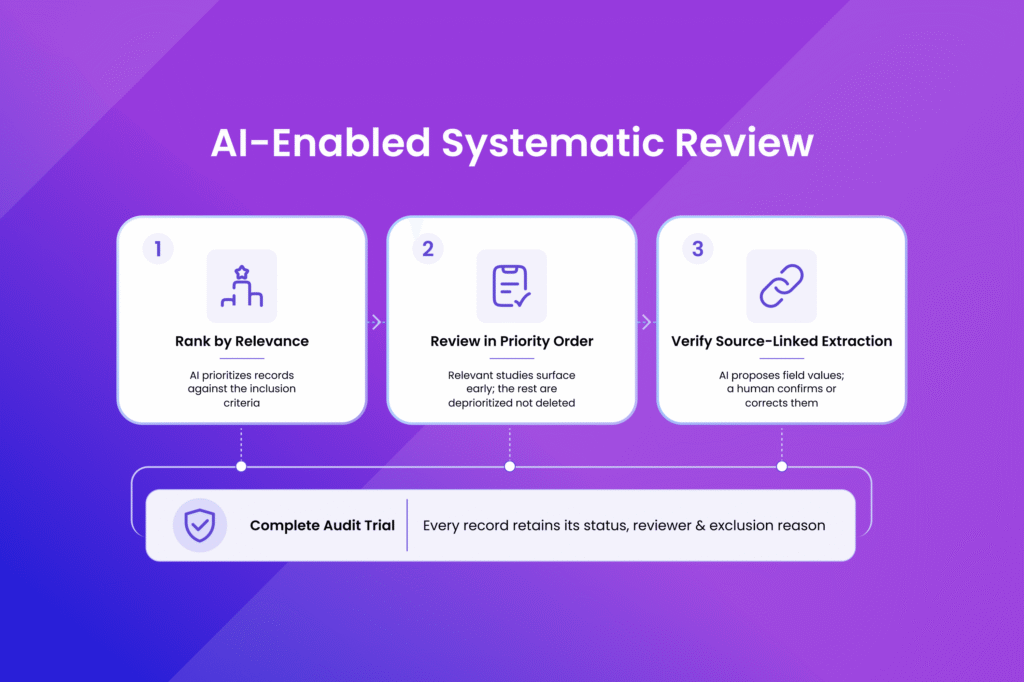
What Manual Literature Reviews Cost, and Where the Money Goes
Manual systematic literature reviews remain the backbone of evidence-based decisions in healthcare, policy, and research. Teams follow strict protocols, search multiple databases, screen thousands of records, extract data by hand, and synthesize findings. The method delivers high-quality results. Yet the true price of this work often stays hidden until the invoices, calendars, and opportunity costs come due.
A single high-quality systematic review can consume the equivalent of more than one full-time scientist-year. One widely cited economic estimate places the average cost near $141,000. Mean completion time from protocol registration to publication sits around 67 weeks, with many projects stretching from six months to two years. Person-hours frequently range from several hundred to well over a thousand, depending on the volume of literature and the number of outcomes examined. Those figures capture only the visible labor. The hidden costs run deeper.
Most life sciences teams underestimate the cost of manual literature reviews because only part of the total reaches an invoice. Salaried hours are visible. The delay, the duplicated effort across sites, and the decisions that sit waiting on evidence are not.
If you are still deciding what kind of synthesis your question needs, our comparison of systematic literature review versus meta-analysis covers where the two diverge in scope and effort.
The Costs That Never Reach the Invoice
Manual literature reviews carry high hidden costs beyond direct labor. These include delays in decision-making, inefficient use of expert time, fatigue-related errors, and duplicated research efforts.
Decision lag. While a review team works for months, new studies appear. Clinical guidelines lag. Market access decisions wait. A dossier submitted with a search cutoff eight months old invites the first question from an assessor.
Displaced expertise. Trained epidemiologists spend weeks reading titles, the overwhelming majority of which are irrelevant, to find the studies that matter. That is triage at scale, and it is not the work they were hired for.
Attrition and error drift. Screening consistency degrades over long sessions. Fatigue produces both false exclusions and slower conflict resolution, and neither shows up as a line item.
Duplicated reviews. A review in progress is invisible to other teams until it is registered or published, so parallel effort on the same question is common across large organizations and across the field.
Where the Manual Literature Review Cost Accumulates
Stage-by-stage, the manual literature review cost is dominated by two activities: study selection and data extraction. Protocol development and the initial search are comparatively cheap. Coordination, conflict resolution, and version control on extraction tables consume more than most plans allow for.
This is also why living systematic reviews stay out of reach for most topics. If each update cycle repeats most of the original screening effort, continuous evidence is priced as an annual project rather than a maintained asset.
How AI-Assisted Workflows Change the Economics
Start with the mechanism, not the percentage, because the mechanism is what a reviewer or an assessor will ask about.
 AI-Enabled Systematic Review
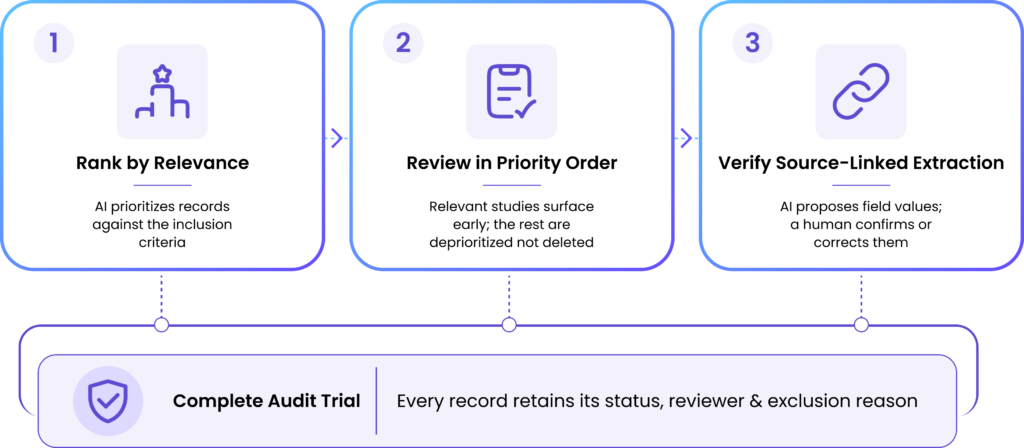
In an AI-enabled systematic review, a model ranks retrieved records by likely relevance against your inclusion criteria rather than returning them in database order. Reviewers work down a prioritized list, so the studies that matter surface early and the clearly irrelevant tail is deprioritized rather than deleted. Every record keeps its status, its reviewer, and its reason for exclusion, so the audit trail is stronger than a spreadsheet, not weaker. Extraction works the same way: the system proposes structured field values with a link back to the source sentence, and a human confirms or corrects each one.
Two things follow from that design. First, the saving is in reading volume, not in judgment. Second, the saving compounds, because a ranked and labeled corpus makes the second pass cheaper. Adjust an inclusion criterion or add a sub-population and you re-rank rather than restart.
Across MadeAi deployments, that translates to evidence delivered around 60 percent faster, cost savings of 50 to 60 percent, extraction accuracy above 90 percent on verified fields, and 96 percent traceability from reported result back to source. For a fuller technical comparison of approaches on the market, see our complete guide to GenAI-enabled literature review.
What AI Does Not Change
Any efficiency claim without its cost attached should be treated as marketing. Four costs remain, and they are real.
Human Oversight in AI-Enabled Reviews
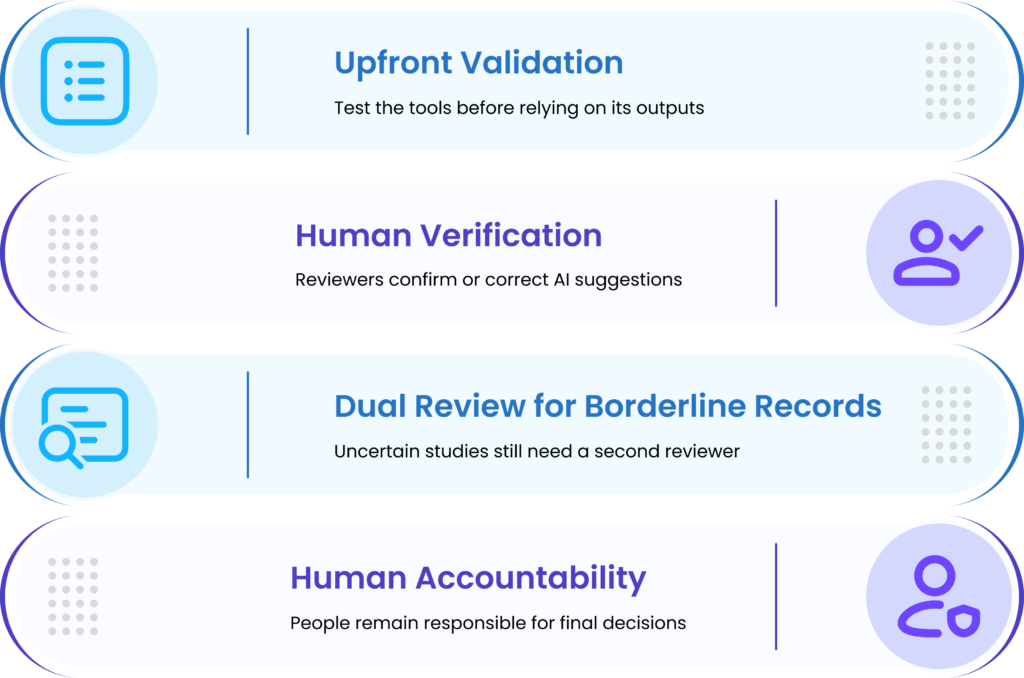
Validation is upfront work. Before a screening model is trusted on a live review, you validate its recall, meaning the share of genuinely relevant records it keeps, against a reference set where the answer is already known. That validation is a project in itself, and it is not optional.
Verification is still labor. Confirming proposed extraction values is faster than reading full texts cold, but it is not free. Budget it explicitly rather than treating extraction as solved.
Borderline records go to humans. The records a model is least certain about are exactly the ones that need two reviewers. Retain dual review there, and expect adjudication time to stay roughly flat.
Accountability does not transfer. Software handles volume and prioritization. Your team retains final responsibility for inclusion decisions, data accuracy, and the synthesis that decision-makers actually use.
There are also reviews where the setup cost does not pay back. Very small evidence bases, questions where the inclusion criteria are still moving, heavily non-English literature, and any project where the sponsor has not agreed in advance to disclose tool use are all better run conventionally.
Whether Assessors Accept AI-Assisted Screening
This is the question that decides procurement, so treat it directly.
Reporting standards govern what you disclose, not what tools you use. PRISMA 2020 asks for the full search strategy per database, the number of reviewers at each stage, how automation tools were used and where, and reasons for exclusion at full text (Page et al., BMJ, 2021). An AI-assisted review that reports all of that is PRISMA-compliant. One that quietly used a screening tool and did not say so is not, whatever its recall.
Health technology assessment bodies including NICE and IQWiG expect submitted evidence syntheses to arrive with search strategies and screening decisions in a form their own reviewers can check. That is an argument for AI-assisted workflows rather than against them, provided the platform logs decisions at record level. A spreadsheet cannot show who excluded record 4,182 and why. A system with 96 percent traceability can.
For the regulatory side of the same question, our note on FDA literature review requirements sets out what to document before you submit.
Manual and AI-Assisted Workflows Side by Side
| Cost Element | Manual Approach | AI-Assisted Hybrid |
|---|---|---|
| Title and abstract screening | Full dual review of every retrieved record | Prioritized review, dual review retained on borderline records |
| Data extraction | Full text read cold, fields entered by hand | Proposed values with source links, human verified |
| Calendar time | Median 67.3 weeks from registration to publication (Borah et al., 2017) | Around 60 percent faster in MadeAi deployments |
| Criteria changes | Near full restart of screening | Re-rank against the existing labeled corpus |
| Audit trail | Spreadsheets and reviewer notes | Record-level decision log, 96 percent traceability |
| Update cycle | Priced as a new project | Priced as maintenance |
How to Run a Defensible Pilot
Do not pilot on a live submission. Use a completed review where you already know the answer.
1. Pick the review. Choose one with at least 2,000 retrieved records and a documented final inclusion list. Smaller sets will not tell you anything about recall.
2. Set the pass threshold before you start. Decide in advance what recall you require against the original inclusion list, and write it down. A common bar is that the tool must surface every included study within the top portion of the ranking that your reviewers would realistically read.
3. Re-run screening only. Hold the search constant so you are testing one variable.
4. Measure four things. Recall against the known inclusion list, reviewer hours, calendar days, and how many records reviewers read before finding the last included study.
5. Handle the awkward cases. If the tool surfaces a relevant study the original review missed, log it as a finding about the original, not a failure of the test.
6. Document every setting. Model version, criteria text, thresholds, and who verified what. If you cannot reproduce the pilot, it does not count as evidence.
When you are ready to compare vendors on these criteria, our roundup of the best AI tools for systematic literature review sets out what to test.
The Next Step
The literature volume will keep rising. The question is no longer whether you can absorb what manual literature reviews cost on a single project. It is whether you can keep absorbing the delay on every project, when the alternative preserves the standards that make the answers usable.
Start with the retrospective pilot above. If you would rather see it run against your own evidence base first, our team can walk through the AI tools for literature review that support it.
Author’s Note: This article was supported by AI-based research and writing, with Claude 5 assisting in the creation of text and images.