

 Meghan Oates-Zalesky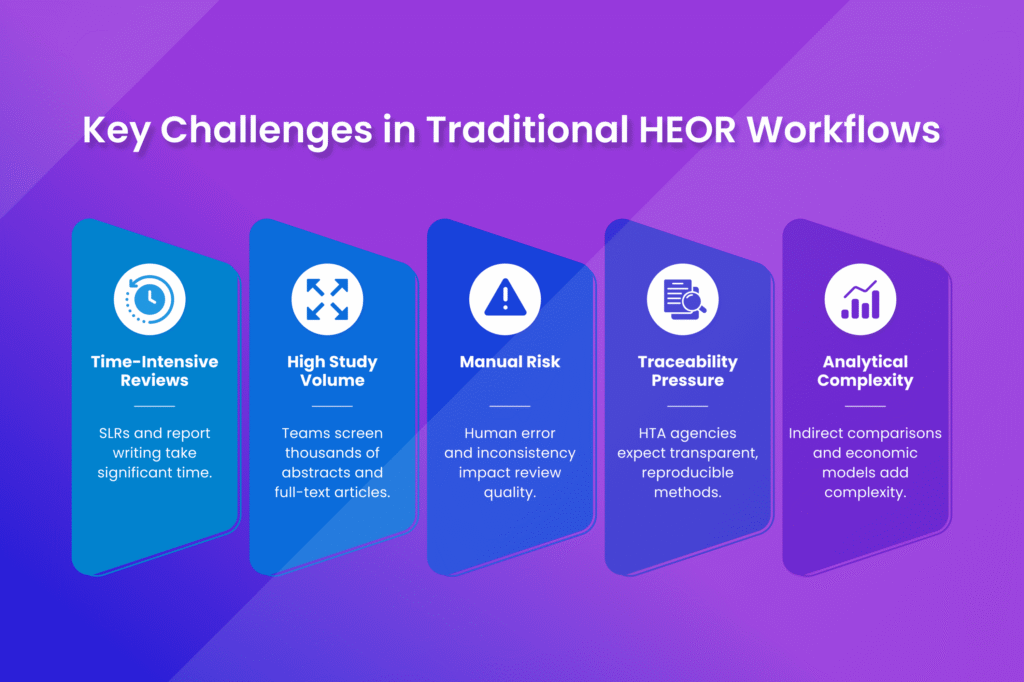
HTA-Ready Evidence Dossiers
HTA (Health Technology Assessment)-ready evidence dossiers represent a critical deliverable for HEOR teams seeking market access and reimbursement for new therapies. These documents compile clinical, economic, and real-world evidence to meet strict requirements from health technology assessment bodies such as NICE, CADTH, or HAS.
HTA-ready evidence dossiers demand more data, tighter timelines, and stricter formatting than ever before. Health technology assessment bodies across Europe, the UK, and North America now expect harmonized evidence within weeks. Literature volumes keep growing every year. Reviewers expect PRISMA-compliant methodology at every step. Regulators expect full traceability for every data source used. Artificial intelligence, applied correctly, closes this gap. It does not replace HEOR expertise or scientific judgment. This blog explains where AI genuinely helps HEOR teams. It also covers where human oversight still matters most. By the end, you will see a practical, AI-assisted path to submission.
The Challenges in Traditional HEOR Evidence Workflows
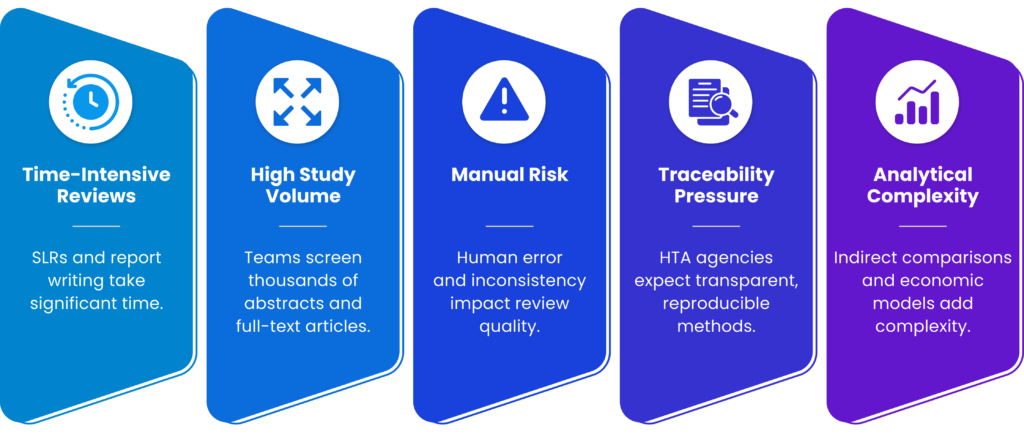
HEOR professionals spend significant time on systematic literature reviews (SLRs), data extraction, quality appraisal, and report writing. A single SLR can involve screening thousands of abstracts and extracting data from hundreds of full-text articles. As a result, this work is prone to human error, inconsistency across team members, and fatigue.
Key Challenges in Traditional HEOR Workflows
Payers and HTA agencies demand transparent, reproducible methods. Any gap in traceability or incomplete synthesis can lead to rejected submissions or requests for additional data. In addition, comparative effectiveness research, indirect treatment comparisons, and economic modeling add layers of complexity. HEOR evidence synthesis with AI addresses these pain points by handling volume while experts focus on interpretation and strategy.
What Makes an Evidence Dossier HTA-Ready
An HTA-ready dossier is more than a literature summary. It aligns evidence to a specific PICO framework upfront. PICO stands for population, intervention, comparator, and outcome. Under the EU Health Technology Assessment Regulation, submission timelines are strict. Manufacturers must submit clinical evidence within 100 days of the first request. Accelerated procedures and label expansions get only 60 days. Missing a PICO or leaving a gap unexplained carries real risk. It can trigger a second request from the assessment body. In some cases, it can discontinue the review entirely. Since January 2025, new cancer medicines have fallen under this joint clinical assessment and advanced therapy medicinal products. Additional therapeutic areas will join in later phases through 2030.
NICE, CADTH, and other national bodies layer their own requirements on top of this EU baseline. A single asset headed for multiple markets may need several dossier variants. However, each variant may present and cite the same underlying evidence differently. Therefore, consistency is essential when developing HTA-ready evidence dossiers. A dossier built for one agency rarely transfers cleanly to another.
| HTA Body | Evidence Scope | Key Standard | Typical Dossier Timeline |
|---|---|---|---|
| EU Joint Clinical Assessment (EMA-linked) | Clinical evidence only | PICO-aligned dossier per Annex I HTA-R | 100 days from first request (60 for accelerated) |
| NICE (UK) | Clinical and economic | Single Technology Appraisal template; AI position statement | Varies by route, often 30 to 90 days |
| CADTH / CDA-AMC (Canada) | Clinical, economic, and RWE | Standardized review templates | 60 to 180 days |
| ICER (United States) | Clinical and economic | Value assessment framework | Varies by review cycle |
Where HEOR Teams Lose Time Building Dossiers
Even well-resourced HEOR teams underestimate this front-loaded cost. Most delays happen before the writing even starts. Analysts spend days screening thousands of abstracts by hand. Full-text extraction requires re-reading the same papers for different data points. Formatting the same evidence into NICE, EMA, and CADTH templates duplicates effort. Moreover, these parallel workstreams rarely share information efficiently. Rare disease programs, however, face a different problem entirely. Sparse published literature forces teams to widen their search terms. Every inclusion decision then needs careful justification for reviewers. Reviewers expect completeness even when the underlying evidence stays thin.
Importantly, these bottlenecks are administrative, not scientific, in nature. They consume analyst time that should go toward interpretation. Instead, that time goes toward reformatting for a third submission template. Version control adds another layer of friction to the process. Evidence tables get copied and re-copied across drafts constantly. A single large systematic review can absorb several hundred analyst hours before a draft even starts. This is exactly where AI-powered literature review services add real value.
How AI-Powered Literature Review Services Accelerate Evidence Synthesis
From Literature Search to HTA-Ready Evidence
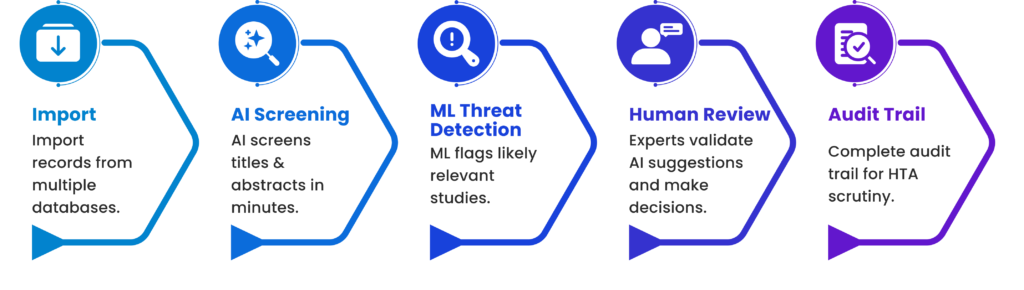
AI-powered literature review services handle the repetitive front end of reviews. Natural language processing models screen titles and abstracts against protocol criteria. As a result, initial screening can take minutes rather than weeks of manual effort. Machine learning classifiers then flag potentially relevant studies for human review. Published evaluations show this can cut manual screening volume by half. PRISMA flow diagrams update automatically as records move through each stage. This keeps the audit trail intact for later HTA scrutiny. Several HTA agencies already permit this kind of AI assistance. NICE, IQWiG, and EUnetHTA have each published relevant guidance. Their guidance addresses machine learning use in evidence generation directly.
From Screening to HTA-Ready Evidence Dossiers in Days
Once screening finishes, AI tools extract structured data points from full texts. This includes sample size, endpoints, comparators, and effect estimates. Structured extraction feeds straight into evidence tables and PROSPERO-registered protocols. Consequently, teams can move more quickly from search strategy to a near-complete evidence base. However, dual review still matters throughout this accelerated process. Every AI-flagged inclusion or exclusion gets a second human check. This keeps Cochrane-standard rigor intact before anything enters the dossier. That checkpoint separates a defensible HTA-ready evidence dossier from a fragile one.
Real-World Evidence and AI for Rare Disease Dossiers
Rare disease and innovative therapy submissions often lack strong trial data. Real-world evidence helps fill that gap for HEOR teams. RWE sources are messy, spanning claims data and patient registries. Electronic health records and social media listening studies count too. AI models process these fragmented sources faster than manual review allows. They surface patient burden data, treatment patterns, and unmet need signals. Social listening research can reveal how patients describe their own symptoms. Because this language rarely appears in structured trial data, combining it with literature synthesis can strengthen the dossier. In particular, it helps teams build a fuller evidence picture for thin-evidence conditions. Payers increasingly expect this kind of triangulated evidence for rare disease value stories.
Governance and Human Oversight in AI-Built Dossiers
Regulators are watching AI use closely across every submission type. Dossiers must reflect that scrutiny at every stage. NICE’s position statement calls on developers to justify their AI use. It asks teams to document assumptions through frameworks like PALISADE. Explainability and human oversight both stay non-negotiable under this guidance. An ISPOR working group report on generative AI echoes this stance. Human expertise remains essential for model conceptualization and result validation. Other agencies are moving in parallel on this issue. Quebec’s INESSS built a screening tool for internal literature reviews. HTAi’s 2025 Global Policy Forum flagged trust as a central theme. Every AI-assisted claim needs a clear audit trail in the dossier. That trail must show how a human reviewer verified it. Formal guidance from bodies like EUnetHTA is still developing. Teams that build this discipline now will adapt faster as formal guidance expands.
How MadeAi Supports HTA-Ready Evidence Dossiers
MadeAi combines AI-powered literature review services with expert scientific review. This helps HEOR teams move faster without cutting corners. The platform supports systematic reviews, targeted reviews, and rapid evidence assessments. Each workflow is built for regulatory and HTA-grade rigor. It keeps every extraction, exclusion, and synthesis step traceable to source data. Advanced AI Solutions for Life Sciences enable workflows that map directly onto NICE and CADTH requirements. They also align with EU joint clinical assessment expectations. Teams exploring HEOR evidence synthesis with AI get one connected evidence base.
Building Dossiers That Hold Up Under Review
HTA-ready evidence dossiers are no longer optional extras for HEOR teams. They are the baseline expectation across every major market now. AI cannot replace the scientific judgment HEOR teams bring to a submission. It can, however, remove the manual bottlenecks that used to slow teams down. Teams that pair AI-powered literature review services with disciplined human oversight benefit most. They move from protocol to submission faster than manual-only teams. They also keep the traceability that regulators expect from a credible dossier. The right AI workflow makes building HTA-Ready Evidence Dossiers easier with every future submission.
Real-World Impact: Time Savings and Improved Quality
Organizations report up to 60% reduction in literature review timelines when using AI platforms. What once took weeks now completes in days. This allows HEOR teams to support more submissions and respond faster to payer queries.
Traceability remains a key strength. Modern platforms log every decision, source, and change. Reviewers can click through to original documents. This level of auditability builds confidence for HTA submissions. Accuracy rates often exceed 90% with human oversight, far surpassing early generic AI attempts.
MadeAi stands out as one such platform designed specifically for these needs. It accelerates evidence synthesis while delivering submission-ready outputs aligned with HTA standards.
Traditional vs. AI-Assisted HEOR Workflows
| Aspect | Traditional Approach | AI-Assisted Approach | Benefit |
|---|---|---|---|
| Literature Screening | Manual review of thousands of abstracts | Automated with high precision | 50-70% time reduction |
| Data Extraction | Spreadsheet by hand | Structured, schema-based extraction | Fewer errors, better consistency |
| Report Generation | Manual drafting | Drafts with traceable sources | Faster iterations |
| Traceability | Limited audit trails | Full provenance and version control | HTA-compliant |
| Team Capacity | Bottlenecks common | Parallel reviews possible | Scale without added headcount |
Future Outlook for HEOR and AI Integration
As evidence requirements evolve, AI will play an even larger role in dynamic dossier updates and personalized value stories. Integration with real-world data platforms will create living evidence repositories. HEOR teams that adopt Advanced AI Solutions for Life Sciences today will lead in speed and quality tomorrow.
Conclusion
HEOR teams can deliver stronger, faster HTA-ready evidence dossiers by embracing AI thoughtfully. The technology handles volume and routine work. Experts focus on insights that drive better patient outcomes and successful market access. With the right tools and processes, the future of evidence generation looks more efficient and impactful.
Author’s Note: This article was supported by AI-based research and writing, with Claude 4.5 assisting in the creation of text and images.