

 Meghan Oates-Zalesky
Scaling Patient-Reported Outcomes
In the world of clinical research and drug development, patients’ own voices matter more than ever. Patient-reported outcomes (PROs) capture how people actually feel, their symptoms, quality of life, side effects, and daily functioning. Yet turning these often messy, free-text or survey responses into clean, structured data that regulators can trust has long been a bottleneck.
Today, AI-powered PRO tools are transforming how patient feedback is collected and analyzed. It helps scale collection, clean the data, standardize it, and prepare it for regulatory submissions faster and more reliably than traditional methods. Let’s explore how this works, why it matters, and what it means for the future of healthcare evidence.
The Challenges
The challenge extends beyond collecting PROs. A single Phase III clinical trial can generate tens of thousands of PRO responses across multiple sites, languages, and digital platforms. Traditionally, teams review these responses manually. They map them to controlled vocabularies, reconcile different measurement scales, and check for inconsistencies or quality issues.
This process is time-intensive, resource-heavy, and increasingly difficult to scale as trials expand from hundreds to thousands of participants. As a result, PRO data often reaches analysis teams later than other clinical data streams. It may also arrive in inconsistent formats when submission timelines are most critical.
The downstream impact can be significant. Delayed availability of structured PRO evidence may slow submission readiness, while inconsistencies in the evidence package can lead to regulatory clarification requests that extend review timelines and require additional effort to address.
The Growing Importance of Patient-Reported Outcomes
PROs have moved from nice-to-have to essential. Regulatory bodies like the FDA and EMA now encourage their inclusion in clinical trials and real-world evidence packages. They provide critical insights that lab numbers or clinician notes often miss.
However, collecting and processing them at scale brings challenges:
- High volume and variety: Thousands of patients across multiple languages, devices, and time points.
- Unstructured data: Free-text entries, inconsistent phrasing, missing responses, or ambiguous answers.
- Time pressure: Manual coding and cleaning can take weeks or months.
- Regulatory scrutiny: Submissions need traceable, unbiased, high-quality data.
Therefore, AI can serve as a powerful accelerator for PRO processing.
How AI Transforms PROs into Structured Evidence
AI technologies for patient insights platforms, especially natural language processing (NLP), machine learning, and large language models, address these pain points step by step.
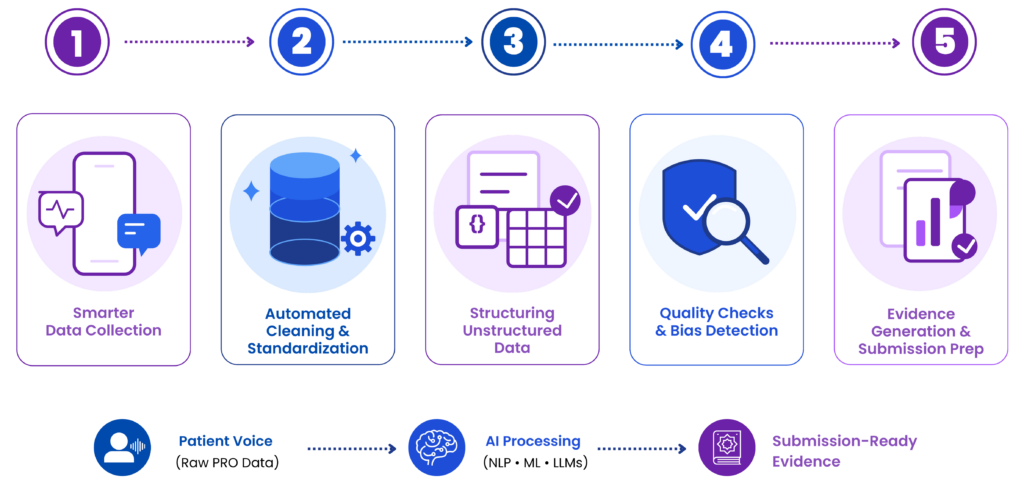 From PRO Data to Submission-Ready Evidence
1. Smarter Data Collection
Electronic PRO (ePRO) systems already let patients report via apps or wearables. AI enhances this with chatbots and adaptive questionnaires that ask follow-up questions in natural language, improving completion rates and reducing dropout.
2. Automated Cleaning and Standardization
AI can detect inconsistencies, fill in missing context intelligently (with human oversight), and map responses to standardized terminologies like SNOMED CT or CDISC standards. For example, “I feel really tired all the time” gets coded reliably into fatigue severity scores.
3. Structuring Unstructured Data
Next, NLP models extract key information from free-text responses and convert them into structured formats suitable for statistical analysis and regulatory review. This process turns raw patient input into analysis-ready datasets.
4. Quality Checks and Bias Detection
AI can identify potential biases, such as demographic underrepresentation, and support validation against reference datasets. This helps align AI-assisted workflows with the FDA’s risk-based approach.
5. Evidence Generation and Submission Prep
AI helps generate summaries, visualizations, and even drafts of clinical study reports, speeding up the path to structured and submission-ready evidence.
Here’s a simple comparison table:
| Aspect | Traditional Approach | AI-Assisted Approach | Benefit |
|---|---|---|---|
| Data Collection | Paper forms or basic ePRO | Adaptive AI chatbots & reminders | Higher completion rates |
| Cleaning & Coding | Manual review by experts | NLP + ML with human oversight | Weeks saved |
| Standardization | Time-intensive mapping | Automated ontology mapping | Regulatory compliance |
| Bias & Quality Control | Periodic manual audits | Real-time flagging & validation | More credible evidence |
| Submission Readiness | Months of preparation | Accelerated structuring & reporting | Faster time-to-market |
Real-World Impact and Regulatory Alignment
The FDA has seen a surge in submissions using AI-assisted patient insights services and has released draft guidance outlining a credibility assessment framework. Similarly, joint FDA-EMA principles emphasize clear context of use, data integrity, and human oversight.
Companies using AI for PROs report faster trial timelines, richer insights, and stronger regulatory packages. For instance, integrating PROs with predictive models helps create more patient-centered “PRO-diction” tools in oncology.
Best Practices for Implementing AI for Patient-Reported Outcomes
Successfully implementing AI in regulated healthcare requires more than technical deployment. It requires a strong foundation for governance, compliance, and quality.
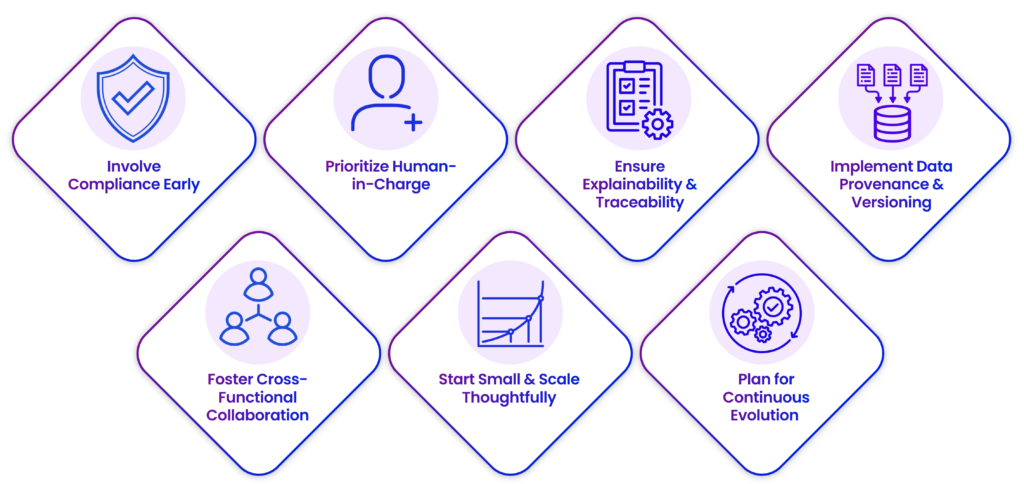 Best Practices for Scaling AI in Pharma
Best practices for scaling include:
- Involve Compliance Early: Privacy and regulatory alignment must be prioritized from the design phase, not added as an afterthought.
- Prioritize Human-in-Charge: For critical applications like pharmacovigilance and evidence generation, maintain robust human oversight to validate outputs and ensure clinical safety.
- Ensure Explainability and Traceability: Utilize model interpretation tools to provide a clear rationale for outputs. Every decision must be traceable from source data to the final result, ensuring audit-readiness.
- Implement Data Provenance & Versioning: Establish clear tracking for data lineage. Maintaining version control is essential to support regulatory submission requirements.
- Foster Cross-Functional Collaboration: Integrate expertise from clinical, data science, regulatory, and quality teams to ensure holistic and secure AI development.
- Start Small and Scale Thoughtfully: Start with well-defined, high-impact use cases, such as systematic evidence synthesis. Validate the business value, optimize workflows, and then scale adoption across the organization.
- Plan for Continuous Evolution: As AI capabilities and regulatory guidance evolve, organizations should regularly reassess their AI systems and workflows. These reviews help maintain validation, compliance, and operational performance.
The Road Ahead
Looking ahead, patient-reported outcomes will extend beyond text-based diaries to include voice recordings, wearable sensor data, and passive symptom tracking. AI will help analyze these diverse inputs and summarize longitudinal trends into concise, review-ready insights. Human reviewers can then validate the findings while maintaining traceability to the original evidence.
At the same time, regulatory guidance is evolving alongside the technology. Agencies are increasingly asking sponsors to document how AI tools were validated, not just what they produced. This means AI patient-reported outcomes work is being treated as a core part of the evidence chain, not a shortcut around it.
AI platform for Life Sciences continue to improve; AI-assisted processing of patient-reported outcomes may become a standard part of evidence generation. This means more efficient drug development, better patient-centric evidence, and ultimately improved treatments that reflect real human experiences.
The technology is here. The opportunity is to use it responsibly by blending AI speed with human judgment to create trustworthy, structured, and submission-ready evidence.
Author’s Note: This article was supported by AI-based research and writing, with Claude 4.5 assisting in the creation of text and images.