

 Meghan Oates-Zalesky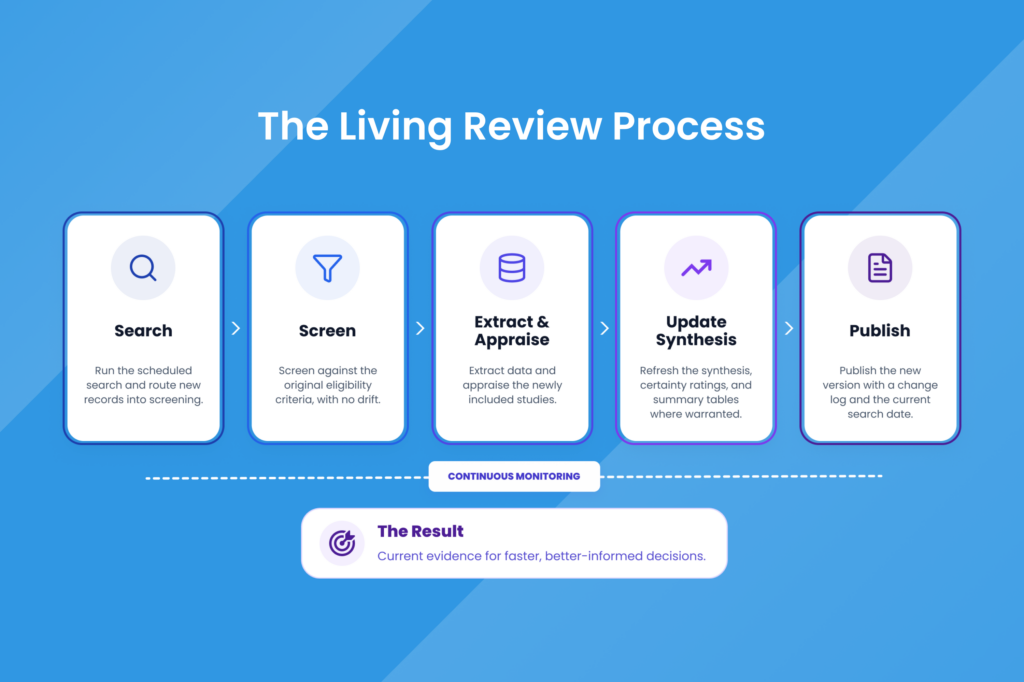
Living Review: Evidence in Real-Time
Living Systematic Reviews exist to solve a timing problem: the evidence base moves while the review is still being written. A review is a photograph. Clinical practice is a film. Between the last search date and the day a decision gets made, new trials report, guidelines shift, and regulators act. As a result, that distance is the evidence gap, and in fast-moving indications it can open within weeks.
Consider a recent example. In September 2026, the FDA granted accelerated approval to camizestrant with a CDK4/6 inhibitor for HR-positive, HER2-negative advanced breast cancer on detection of an ESR1 mutation, and approved Guardant360 CDx as the companion diagnostic (ASCO Post, September 2026). It was the first time the agency cleared a cancer therapy guided by a resistance mutation found in circulating tumor DNA before imaging showed progression. Notably, an advisory committee had voted 6 to 3 against the approval, and confirmatory trials are required. Any review of treatment sequencing in that setting, finished the month before, now describes a different standard of care.
Living Systematic Reviews answer this by treating evidence as a maintained asset rather than a finished project. With AI supporting this continuous process, Living Systematic Reviews become scalable for the speed of today’s clinical landscape. For a quick overview of how MadeAi supports continuously updated, AI-enabled literature reviews, watch our Living Review video.
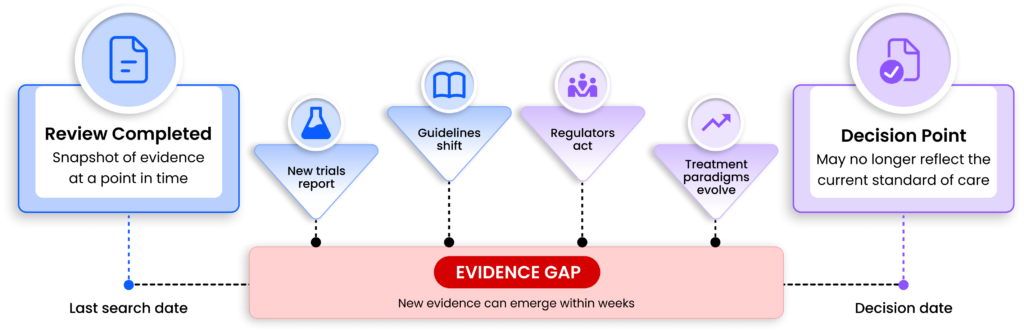
The Evidence Gap in a Changing Clinical Landscape
Living Review: The Industry Context
How the Evidence Gap Affects the Pharma Industry
That gap does not stay limited to the literature review. It flows downstream into several high-stakes activities:
- Global Value Dossier updates that must reflect the latest comparative data
- AMCP dossiers that payers expect to match current treatment paradigms
- Competitive value stories that position products against evolving standards of care
- HTA preparation and Joint Clinical Assessment readiness, where evidence must support specific PI(E)COs under tight timelines
- Internal evidence planning that prioritizes future studies or real-world evidence generation
- Medical Affairs activities such as medical information responses, advisory boards, publication planning, and KOL engagement
When evidence lags, teams either delay decisions or restart full reviews under time pressure. Living Systematic Reviews close this gap by design. They keep the methodological standards of conventional reviews while adding continuous monitoring and structured incorporation of new evidence, in line with guidance from Cochrane and the Living Evidence Network.
How a Living Review Works
A living review is not a different methodology. It applies standard systematic review methods with an explicit, advance commitment to continued searching and updating. The approach was first proposed in 2014 as a response to the decay in currency and accuracy that affects reviews between updates.
Protocol Decisions You Make Once
Settle these before the first search, because changing them later breaks comparability between versions.
- How often you will search, plus any event-based triggers such as a pivotal readout or a regulatory decision
- What threshold of new evidence changes the synthesis rather than simply being added to it
- Whether you re-run meta-analysis every cycle or only when new data could change direction or certainty
- How you will version the review and format the change log
- Who signs off on eligibility calls and interpretation
Guidance from the living review community sets three conditions for choosing this approach: the question is a priority for policy or practice, the current evidence carries real uncertainty, and new research is expected that could change what we know. If a topic fails any one of them, a scheduled conventional update is the better answer.
The Surveillance Cycle You Repeat
- Run the scheduled search and route new records into screening
- Screen against the original eligibility criteria, with no drift
- Extract data and appraise the newly included studies
- Refresh the synthesis, certainty ratings, and summary tables where warranted
- Publish the new version with a change log and the current search date
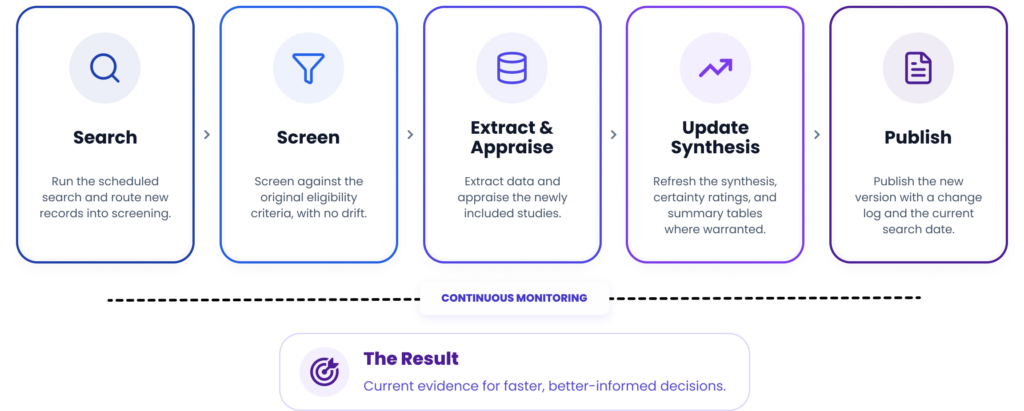
The Living Review Process
Currency has to be evidenced, not declared. A study of Cochrane’s COVID-19 living reviews examined how far their included evidence actually kept pace with the literature, which is a useful reminder that the change log is the proof (De Silva et al., 2025).
Living Review: The Architecture
The difference between a living review that works and one that stalls is architectural. Each layer has to produce an artifact the next cycle can reuse. When any layer produces only a result, the team rebuilds it next quarter.
| Layer | What it Does | Artifact it Must Leave Behind |
|---|---|---|
| Question and criteria | Holds the PI(E)COS frame and eligibility rules | Versioned criteria set with a change history |
| Search and retrieval | Runs scheduled and triggered searches | Executed query string, database, date, and record list |
| Deduplication | Removes records already assessed | Counts reconciled to the previous cycle |
| Screening | Sorts new records against the original criteria | Record-level decisions with rationale |
| Extraction and appraisal | Captures outcomes and risk of bias | Structured evidence table with source links |
| Synthesis | Refreshes narrative and quantitative results | Statements bound to the records supporting them |
| Versioning and governance | Publishes and controls access | Change log, search date, and reviewer sign-off |
Two design choices matter most. First, keep the criteria and the search strategy as structured, editable objects rather than prose buried in a protocol document. Second, bind every synthesis statement to its source record. Verification then becomes a click instead of a search, which is what makes a quarterly refresh affordable.
Where AI Helps and Where It Does Not
How AI Supports Living Systematic Reviews at Scale
Surveillance and screening repeat on every cycle, so automation earns its place there first. Published evaluations support meaningful savings, though the range is wide and depends on the corpus. A prioritization study across ten completed reviews reported a median reduction in screening burden of 47.1% at a true recall of 95%. A synthesis of natural language processing approaches to abstract screening places reported workload reduction between 13% and 96%, clustering between 30% and 60%, with most studies retaining recall above 90% (PMC, 2026). More recently, a development and validation study applied AI-assisted screening to an economic burden review and reported its performance against human decisions.
Interpretation benefits too. An AI research summarization tool can turn a newly included full text into a structured, source-linked summary in minutes, which keeps the update cycle moving between formal refreshes.
Set the recall target before you configure anything. Then validate on a corpus from your own therapeutic area, because performance does not transfer reliably between review types. For a fuller treatment of how these components fit together, see our guide to the AI-assisted SLR process and the complete guide to GenAI-enabled literature review.
What Still Needs a Human
Accountability does not transfer to the tool. Cochrane, the Campbell Collaboration, JBI, and the Collaboration for Environmental Evidence confirmed that evidence synthesists remain responsible for their synthesis, that human oversight is required, and that any AI use which makes or suggests judgments must be reported transparently (joint position statement, 2025). In a living review, this means the change log records how new evidence was identified, not only what changed.
Keep named reviewers on eligibility calls, risk of bias for complex designs, and interpretation. Reporting still follows PRISMA 2020, whatever the cadence. For broader context on this shift in research workflows, see how AI is changing systematic research.
Comparison of Review Models
| Dimension | Static Systematic Review | Manual Living Review | Technology-Supported Living Review |
|---|---|---|---|
| Search cadence | One-time, occasional updates | Fixed intervals set in the protocol | Scheduled plus event-triggered |
| Effort profile | High burst, then idle | Sustained specialist time | Sustained, with screening load reduced |
| Traceability | Snapshot at one search date | Versioned with change logs | Versioned with source-linked records |
| Readiness for HTA or JCA | Requires a full re-run | Feasible but labor intensive | Maintained and re-cuttable by PICO |
| Reuse across question variants | Costly | Partial | Built in through stored criteria and queries |
| Main constraint | Currency decay | Reviewer capacity | Validation and oversight discipline |
Use Cases
- HTA and joint clinical assessment. Maintain one evidence base and re-cut it for different PICO scopes without restarting the search.
- Safety surveillance. Feed new safety data continuously into the review that supports periodic reporting.
- Guideline and advisory support. Update recommendations as soon as a pivotal trial reports.
- Competitive and pipeline intelligence. Track comparator evidence while it moves, not after.
- Medical information. Give Global medical affairs teams current, source-linked answers for rapid response and congress preparation.
Best Practices
- Write update frequency, triggers, and incorporation rules into the protocol before the first search runs.
- Apply the three-condition test honestly, and decline topics that fail it.
- Standardize the evidence table structure so new studies slot in without reformatting.
- Set a recall target per review type, then validate screening performance against a human-adjudicated sample.
- Keep named humans on eligibility, complex bias assessment, and interpretation.
- Record tool, version, stage, and oversight design as you work, not afterward.
- Publish the current search date with every version, so users can judge currency.
- Assign an owner and a budget line, because a living review does not finish.
Limitations
Living Systematic Reviews carry real costs, and the honest version of the case includes them. Cost is continuous rather than bounded. Topics with a low publication rate rarely repay the surveillance overhead.
Repeated analysis carries a statistical cost. Re-running a meta-analysis at every update raises the multiple-testing concern that applies to any sequentially analyzed dataset. Specify how you will handle it in the protocol instead of deciding mid-cycle.
Automation shifts effort rather than removing it. High recall often arrives with low precision, which moves work into full-text review. In addition, complex study designs, non-English sources, and grey literature remain weak spots for automated screening.
Finally, do not use a living review where the deliverable requires a protocol-locked, one-time synthesis, where the topic is stable, or where nobody owns the update cycle after launch. An unmaintained living review is worse than a clearly dated static one, because users assume currency that is not there.
Living Review – The Future
Three developments will shape the next two years. First, evidence synthesis is becoming maintained infrastructure rather than a series of projects. Teams that adopt Advanced AI Solutions for Life Sciences now will absorb the next practice change faster than teams that treat each review as a fresh build.
Second, validation will replace marketing claims in procurement. Buyers are already asking vendors which dataset produced a performance figure, what served as the reference standard, and what recall target the efficiency number assumes.
Third, tighter integration with trial registries and preprint feeds will shorten the interval between publication and incorporation. Generative AI Life Sciences capabilities will handle more of the routing and drafting, while human reviewers concentrate on the judgments that carry consequences.
Conclusion
The camizestrant decision will not be the last time practice moves before the evidence base does. Living Systematic Reviews do not promise a faster review. They promise a different relationship with the literature, in which the question stays open, every version states what it knows and when it last looked, and the next change gets absorbed rather than triggering a restart.
If you are deciding where to begin, pick one high-priority question where you already expect new data within twelve months. Write the update triggers into the protocol, run two full cycles, and measure what each cycle actually costs before you commit further. That evidence will tell you more than any vendor comparison. MadeAi publishes further practical material on evidence synthesis workflows for teams working through the same decision.
Author’s Note: This article was supported by AI-based research and writing, with Claude 5 assisting in the creation of text and images.