

 Meghan Oates-Zalesky
AI in Real-World Evidence: Why the Evidence Base Moved Outside the Trial
AI in Real-World Evidence (RWE) has moved from pilot project to operating requirement because regulators, payers, and medical affairs teams now ask questions that randomized controlled trials (RCTs) were never designed to answer. How does a therapy perform in patients over 75 with three comorbidities? What happens to adherence outside a trial protocol? Which comparator does a German payer care about, and does anyone treat patients that way in Spain?
An RCT answers one question with high internal validity: does this intervention work under controlled conditions? Real-world data (RWD), meaning data on patient health status and care delivery collected during routine practice, answers a different one: what happens when the protocol ends, and ordinary medicine begins. RWE is the clinical evidence derived from analyzing that data.
The constraint has never been availability. Electronic health records (EHRs), claims databases, registries, and patient-reported outcomes already hold decades of patient experience. The constraint is that the most decision-relevant information sits in unstructured clinical narrative, and turning it into an analyzable cohort has historically required trained abstractors reading charts one at a time. That is the bottleneck AI removes.
The Limits of Traditional Clinical Trials and the Rise of RWE
Trial eligibility criteria exist to reduce noise, and they succeed. They also exclude much of the population that will eventually receive the product. Consequently, sponsors reach launch with strong efficacy data and thin evidence of effectiveness in the patients they forecast for.
| Dimension | Randomized Controlled Trial | RWE Study |
|---|---|---|
| Primary strength | Internal validity, causal inference | External validity, generalizability |
| Population | Narrow, protocol-defined | Broad, includes comorbid and elderly patients |
| Comparator | Placebo or single active control | Local standard of care, often multiple |
| Endpoints | Adjudicated, prespecified | Derived from routine documentation |
| Follow-up | Fixed duration | Longitudinal, limited by data continuity |
| Dominant bias risk | Selection at enrollment | Confounding, misclassification, missingness |
| Typical timeline | Years | Weeks to months once data access exists |
How AI Processes RWD into RWE
AI applications in this domain fall into several complementary categories.
Data extraction and phenotyping. NLP and LLMs parse free-text clinical notes, pathology reports, and discharge summaries to identify diagnoses, treatments, outcomes, and covariates that structured fields miss. Studies have shown NLP approaches achieving high F1 scores for key clinical concepts compared with purely manual abstraction. Phenotyping algorithms can define complex patient cohorts more consistently across sites.
Causal inference and study design. Techniques such as propensity score matching, inverse probability weighting, and target-trial emulation help reduce confounding when randomization is absent. ML models assist in variable selection and missing-data imputation while remaining transparent enough for regulatory review.
Synthetic data and external controls. Generative models can create privacy-preserving synthetic patient records that preserve statistical properties of the original data. Synthetic or external control arms drawn from RWD have supported regulatory submissions and reduced the number of patients needed in certain trials.
Continuous surveillance and evidence synthesis. AI monitors incoming claims or EHR streams for safety signals and supports living systematic reviews that keep evidence current. Literature screening and extraction, long a bottleneck in evidence generation, benefit from prioritization models and LLM-assisted abstraction.
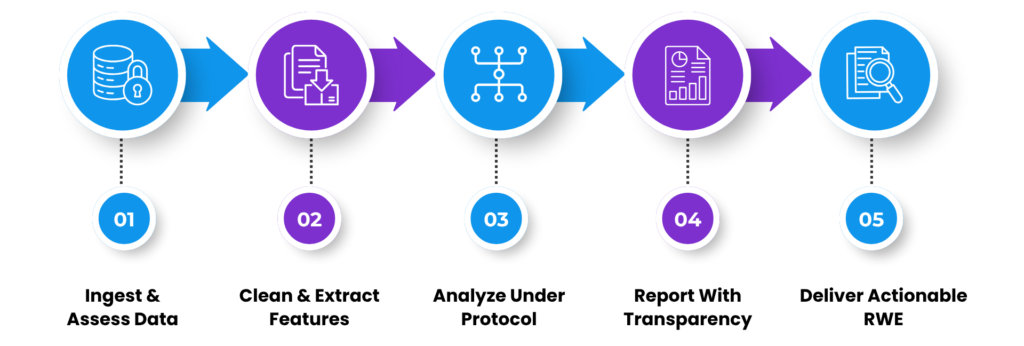
AI-Enabled RWE Workflow
A typical workflow begins with data ingestion and quality assessment, moves through AI-assisted cleaning and feature extraction, applies statistical or ML analysis under a pre-specified protocol, and ends with transparent reporting that includes data provenance, model versioning, and validation metrics. Federated learning approaches allow analysis across institutions without centralizing identifiable patient data, addressing privacy and governance concerns.
Key Capabilities of AI in RWE and Their Benefits
Organizations applying AI in RWE report measurable gains in speed, coverage, and actionability.
- Faster cohort identification and endpoint extraction reduce months of manual chart review to weeks or days.
- Broader population representation improves generalizability for underrepresented groups and rare conditions.
- Near-real-time insights support adaptive trial design, adherence interventions, and post-marketing safety.
- Synthetic controls and external arms can lower sample-size requirements and accelerate timelines in selected settings.
- Integrated evidence packages strengthen HTA and payer submissions by combining trial results with real-world outcomes and economic data.
These benefits are most reliable when AI operates under human oversight and rigorous validation. Accuracy metrics, audit trails, and fitness-for-purpose assessments remain essential.
Practical Use Cases Across the Product Lifecycle
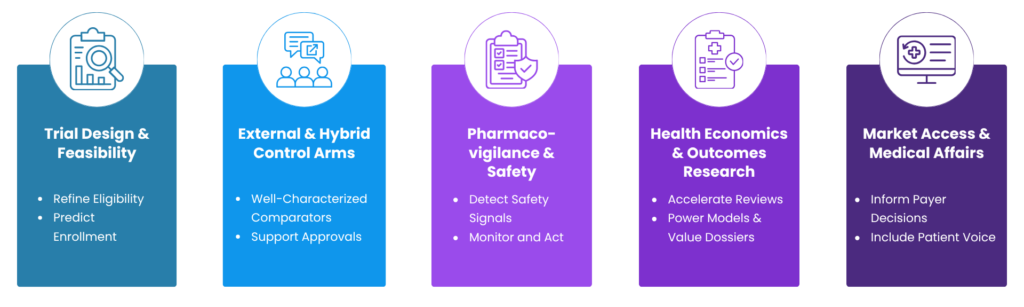
AI-Powered RWE in Action
Trial design and feasibility. AI analyzes historical RWD to refine eligibility criteria, predict enrollment rates, and identify high-performing sites, reducing non-enrolling sites and protocol amendments.
External and hybrid control arms. In oncology and rare disease settings, well-characterized RWD cohorts have served as comparators, supporting approvals and label expansions when traditional randomization is impractical.
Pharmacovigilance and safety. NLP scans unstructured reports and literature for adverse events; ML models detect patterns that rule-based systems miss.
Health economics and outcomes research (HEOR). AI accelerates systematic literature review (SLR) services and data extraction for cost-effectiveness models, treatment pathway analyses, and value dossiers. Teams use AI tools for systematic review to screen thousands of records while maintaining traceability required by HTA bodies.
Market access and medical affairs. Continuous RWE generation informs payer negotiations, medical information responses, and disease-burden studies that incorporate patient voice from social and digital sources.
In each case, the strongest results come from pairing domain expertise with purpose-built technology rather than generic models.
Best Practices for Implementation
Successful programs share common practices:
- Define the estimand and protocol before analysis begins. Pre-specification reduces the risk of data dredging.
- Assess data fitness for the specific question, such as relevance, reliability, completeness, and representativeness.
- Validate AI components against gold-standard human abstraction or known outcomes; report performance metrics transparently.
- Maintain full audit trails, including model versions, prompts, and human review decisions.
- Combine AI with expert scientific review, especially for complex judgments and final interpretation.
- Engage regulators early when RWE will support submissions.
- Address bias, fairness, and privacy through diverse training data, fairness audits, and privacy-preserving methods such as federated analytics or de-identification.
For evidence synthesis that underpins RWE studies, teams increasingly turn to specialized AI platforms for Life Sciences solutions. Platforms such as MadeAi integrate screening, extraction, and reporting workflows while preserving the human oversight that regulatory and HTA audiences expect. Organizations evaluating SLR services or AI tools for systematic review can examine how these capabilities shorten timelines without sacrificing quality. See related discussions on how AI is cutting SLR timelines and the distinctions between SLR versus meta-analysis for further methodological context. Considerations around generative AI for SLR also remain relevant when scaling living evidence approaches.
Risks, Limitations, and Mitigations
AI does not eliminate the fundamental challenges of observational data. Confounding, selection bias, missingness, and measurement error persist. Model opacity can hinder regulatory acceptance if methods lack transparency. Hallucinations or systematic errors in LLM outputs require continuous human validation. Data privacy regulations and institutional governance can limit access or sharing. Over-reliance on AI without domain expertise risks producing results that look precise but lack clinical or regulatory credibility.
Mitigation centers on the practices listed above: pre-specification, rigorous validation, transparency, and hybrid human-AI workflows. Not every question is suitable for RWE; RCTs retain primacy when strong causal claims under controlled conditions are required.
Future Trends
Several developments will shape the next phase of AI in RWE. Regulatory frameworks continue to mature, with clearer pathways for de-identified and aggregate data and for AI-enabled endpoints. Multimodal models that integrate text, imaging, genomics, and sensor data will expand the richness of phenotypes. Agent-based systems may automate larger portions of analysis pipelines while keeping humans in the decision loop. Federated and privacy-enhancing technologies will enable larger, more diverse networks. Living systematic reviews supported by AI prioritization will keep evidence current for rapidly evolving therapeutic areas. Integration of RWE with generative AI for dossier drafting and scenario modeling will further compress evidence-to-decision cycles.
Organizations that treat AI as an augmentation of the scientific method rather than a replacement will be best positioned to generate decision-grade evidence.
Conclusion
Clinical trials will continue to anchor efficacy claims, yet they cannot answer every question that patients, clinicians, regulators, and payers ask. AI in RWE expands the evidence base by making large-scale, heterogeneous data usable, analyzable, and actionable. When grounded in sound study design, transparent methods, and expert oversight, these approaches deliver faster insights, broader generalizability, and stronger support for regulatory and access decisions.
For life sciences teams evaluating their next steps, the priority is clear: build capability in data fitness assessment, hybrid AI-human workflows, and transparent reporting. A well-chosen life science solution that combines an AI platform for Life Sciences with experienced scientific support can accelerate the transition from raw RWD to reliable RWE. Explore how MadeAi supports evidence generation across HEOR, medical affairs, and regulatory needs, and start with a focused pilot on literature synthesis or cohort definition to demonstrate value quickly.
Author’s Note: This article was supported by AI-based research and writing, with Claude 5 assisting in the creation of text and images.