
 Meghan Oates-Zalesky
Agentic AI vs. Generative AI
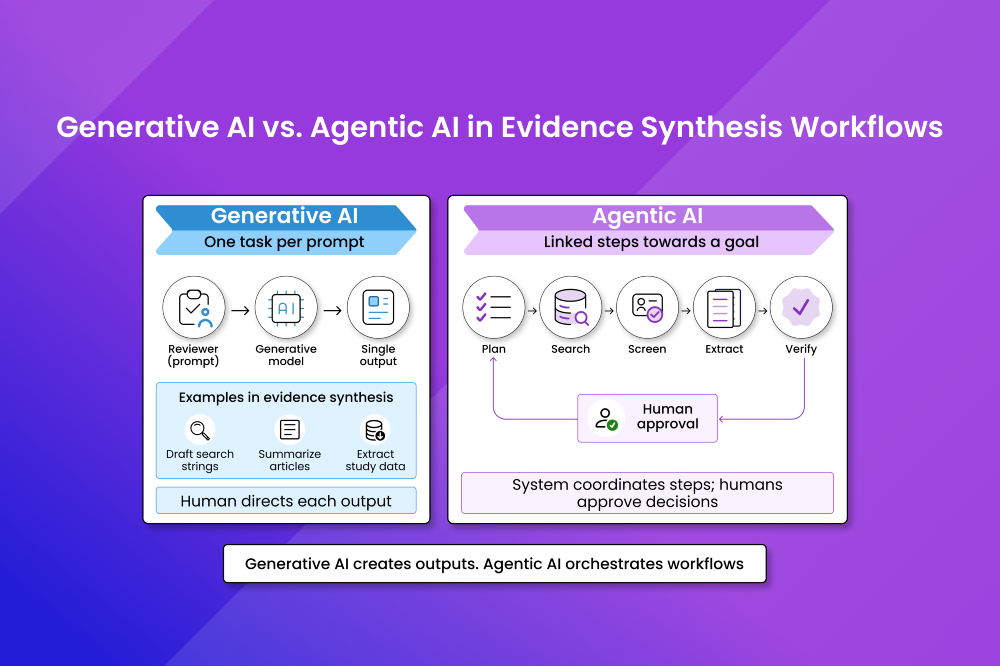
Agentic AI and generative AI differ fundamentally in autonomy and their roles in evidence synthesis workflows. Generative AI produces text, summaries, or extractions from prompts and training patterns. Agentic AI plans multi-step tasks, invokes tools, maintains state, and iterates toward a defined goal with human checkpoints. Both technologies now appear in systematic literature reviews and related life sciences processes, yet they solve different problems and carry distinct requirements for governance, validation, and regulatory defensibility.
Evidence synthesis teams in pharmaceutical, biotechnology, and medical device organizations face rising volumes of literature, compressed HTA timelines, and strict demands for PRISMA-aligned traceability. Traditional manual screening and extraction cannot scale efficiently. Generative AI accelerates discrete tasks such as title-abstract screening or structured data extraction. Agentic systems extend this capability by orchestrating entire pipelines from protocol refinement through synthesis and reporting. Understanding the distinction prevents over-reliance on generative models for end-to-end work and under-utilization of agentic architectures where controlled autonomy adds value.
Why Does the Distinction Matter for Evidence Teams Now?
The distinction matters because the two approaches carry different risks, and assessors now ask how a team used AI. Evidence synthesis is the structured process of finding, appraising, and combining all studies that answer a defined question. Manual methods struggle with that workload, as the comparison of AI-assisted and traditional systematic literature reviews shows.
Meanwhile, deadlines have moved outside the company. Under the EU HTA Regulation, Joint Clinical Assessments (JCAs) began in January 2025 for oncology medicines and advanced therapies, and they extend to all new medicines by 2030. Consequently, buyers of literature review services for life sciences now meet an autonomy claim in almost every vendor proposal.
However, the label often outruns the product. Gartner (2025) predicts that organizations will cancel more than 40 percent of agentic AI projects by the end of 2027 because of escalating costs, unclear business value, or inadequate risk controls. Gartner also estimates that only about 130 of the thousands of vendors that claim agentic capabilities deliver them. Therefore, evidence leaders need a working definition before they evaluate a tool.
What Is Generative AI in Evidence Synthesis?
Generative AI is a class of models that creates new text, tables, or code in response to a prompt. IBM describes it as AI that produces original content when a user asks for it. A large language model (LLM) predicts the next word from patterns in its training data, so each response is a single, self-contained output.
In practice, most generative AI life sciences teams use it today as an assistant. A reviewer asks, the model answers, and the reviewer decides what happens next. Typical tasks include the following:
- The model drafts Boolean search strings from a PICO question.
- The model suggests an include or exclude decision for one abstract.
- The model summarizes a full-text article or drafts a table row.
- The model rewrites a results section in plain language.
The evidence supports generative AI as a supervised assistant. Clark et al. (2025) reviewed 19 comparative studies and concluded that current evidence does not support generative AI use in evidence synthesis without human oversight. In that review, generative AI searches missed a median of 91 percent of relevant studies.
What Is Agentic AI in Evidence Synthesis?
Agentic AI is a system that pursues a goal through a loop of planning, acting, and checking, with limited supervision. It usually relies on a generative model as its reasoning engine. In addition, it adds four components:
- A planner splits the goal into ordered steps.
- Tools such as database connectors and PDF parsers let the system act.
- Memory carries the protocol and earlier decisions across steps.
- A control loop evaluates each result and decides the next action.
How Agentic AI vs. Generative AI Plays Out in One Review Task
Consider a living review update. With generative AI, a reviewer pastes each new abstract into a prompt and records the answer. With agentic AI, the system reruns the saved search on schedule, removes duplicates, screens new records against the protocol, extracts data from included studies, and queues every decision for reviewer approval.
Early evidence is promising but preliminary. Cao et al. (2025) tested an end-to-end agentic workflow called otto-SR in a preprint that has not completed peer review. The authors reported 96.7 percent screening sensitivity against 81.7 percent for dual human review, and 93.1 percent extraction accuracy against 79.7 percent. Independent replication therefore remains necessary before teams rely on these figures.
How Do the Two Approaches Compare Side by Side?
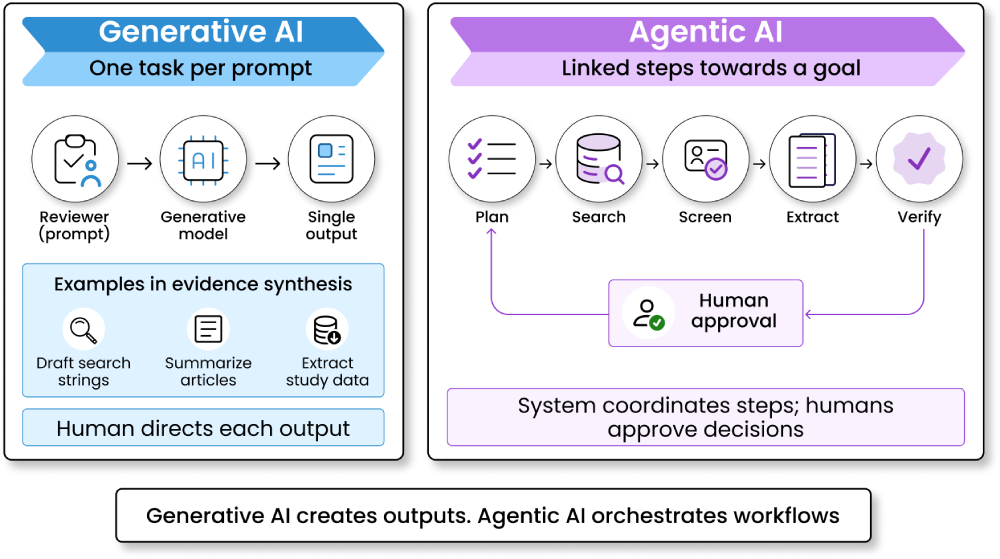
The core contrast is control: a person directs every generative output, whereas an agentic system directs its own steps between human approval gates. The table below summarizes Agentic AI vs. Generative AI across eight dimensions that matter in a regulated review.
Comparison of Generative AI and Agentic AI in Evidence Synthesis
| Dimension | Generative AI | Agentic AI |
|---|---|---|
| Trigger | A person prompts each output. | A goal or schedule starts a multistep run. |
| Unit of work | It completes one task per prompt. | It completes a chain of linked tasks. |
| Tool use | It works inside a chat or editor. | It calls databases, parsers, and analysis tools. |
| Memory | It holds context for one session. | It carries the protocol and prior decisions across steps. |
| Typical SLR role | It drafts search strings, summaries, and text. | It runs searches, screening, extraction, and updates. |
| Main risk | A fluent error appears in one output. | An early error flows into later steps. |
| Human control | The reviewer checks each output. | The reviewer approves work at defined gates. |
| Audit need | The team logs prompts and outputs. | The team logs every step, tool call, and approval. |
How Does an Agentic SLR Workflow Operate?
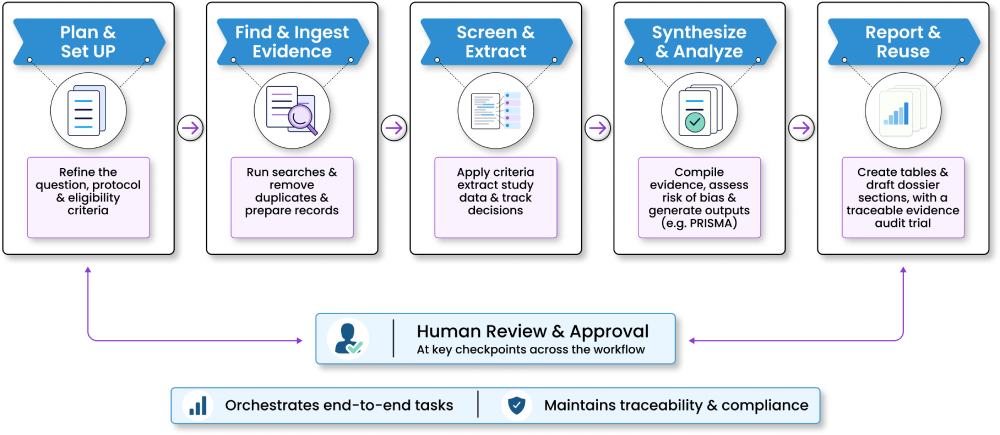
An agentic SLR workflow assigns each review stage to a specialized agent and places a human approval gate between stages. An orchestrator coordinates the agents and records each action. The workflow follows six steps:
- The reviewer registers the protocol, including the PICO criteria and the recall target.
- A search agent runs the approved strategy across databases and logs each query.
- A screening agent classifies each record and states its reason.
- An extraction agent places data into structured fields and links each value to its source passage.
- A verification agent checks the outputs against the protocol and flags conflicts.
- A named reviewer approves, edits, or rejects the flagged items before synthesis begins.
Retrieval grounding supports every step. The system retrieves source documents first and generates text second, so a reviewer can open the passage behind each claim. Furthermore, quantitative pooling remains a statistical task, as the guide to systematic literature review versus meta-analysis explains. MadeAi applies this gated pattern in its literature review workflow, where AI output carries source attribution and a reviewer confirms each decision.
Where Does Each Approach Fit? Use Cases and Benefits
Each approach fits a different kind of work. Generative AI suits bounded drafting tasks, whereas agentic AI suits repeatable, multistep processes with explicit rules. Four examples illustrate the split:
- HEOR. Teams that run HEOR evidence synthesis with AI use agents to refresh a living SLR on schedule, and they use generative drafting for evidence table narratives.
- Market access. Dossier teams use agents to map evidence to each PICO in a JCA scope, and they use generative AI to draft summaries for expert review.
- Clinical development. Teams in clinical operations in pharma use generative AI to summarize prior trials for protocol design, and they use agents to monitor new safety publications.
- Medical affairs. Medical information teams use generative AI to draft response letters from an approved evidence base.
The benefits differ accordingly. Generative AI shortens individual tasks, yet the reviewer still moves work between steps. Agentic AI removes those handoffs, so it shortens the whole cycle and keeps one continuous audit trail. As a result, reviewers spend more time on appraisal and interpretation.
What Are the Risks and Limitations of Each Approach?
Both approaches make errors, but agentic systems can compound them across steps. Five risks deserve attention:
- Fabrication. Generative models can produce citations or values that no source supports.
- Error propagation. A wrong exclusion at screening removes a study from extraction and synthesis, and no later step recovers it.
- Limited evidence. Most performance studies cover single tasks, and the leading end-to-end study remains a preprint.
- Reproducibility. Model updates and prompt changes can alter results between runs.
- Over-trust. Fluent output and long autonomous runs can reduce reviewer scrutiny.
Regulators and methods bodies address these risks directly. The NICE (2024) position statement asks submitting organizations to justify AI use and to keep humans in decision-making. Similarly, the joint statement from Cochrane, the Campbell Collaboration, JBI, and CEE (2025) requires transparent reporting of any AI that makes or suggests judgments. These expectations apply whatever level of autonomy a tool has.
Best Practices for Choosing and Governing AI in an SLR
The best practice is to match autonomy to the cost of an error. Five steps put that principle into operation:
- Classify each task by error cost, and reserve full human review for effect estimates and exclusion decisions.
- Start with generative assistance on one stage, and measure recall against a completed review.
- Add agents only where the rules are explicit, such as deduplication, scheduled searches, and first-pass screening.
- Require an approval gate and a complete log between every stage.
- Revalidate after each model or prompt change, and report the AI tool, version, and role.
Buyers can also test a vendor claim with three questions. Does the system plan its own steps? Can the system call tools without a prompt for each action? Are all actions captured in an audit log? A product that fails these tests is a generative assistant, whatever its label says. The guide on how to choose a systematic literature review platform lists further criteria, and the same tests apply to outsourced systematic literature review services.
What Comes Next for AI in Evidence Synthesis?
The two approaches will converge inside governed platforms, and reporting standards will tighten. First, more enterprise software will embed agents. Gartner (2025) expects 33 percent of enterprise applications to include agentic AI by 2028, up from less than 1 percent in 2024. Second, JCA scope will expand to orphan medicines in 2028 and to all new medicines in 2030, which increases demand for continuously updated evidence. Third, disclosure will become routine as methods bodies align on the RAISE recommendations for responsible AI use. Consequently, the competitive question will shift from model capability to validation evidence and audit quality.
Conclusion: Choose the Level of Autonomy First
Agentic AI vs. Generative AI is not a binary choice between two competing technologies. Generative AI supplies rapid, high-quality content generation and extraction. Agentic AI supplies the planning, tool coordination, and state management needed for complex multi-stage evidence synthesis. Organizations that understand the complementary strengths of each, embed robust human checkpoints, and demand full provenance will accelerate evidence generation without sacrificing the scientific rigor required for HTA, regulatory, and clinical decision-making. Platforms purpose-built for life sciences, such as MadeAi, already demonstrate how these capabilities can operate together inside controlled, auditable workflows.
For teams ready to evaluate concrete options, begin by mapping current bottlenecks against the capabilities described above and test candidate systems on a representative protocol with dual human validation. Clear measurement of accuracy, time savings, and traceability will reveal which combination of generative and agentic features best serves the organization’s evidence needs.