

 Meghan Oates-Zalesky
AI-Native Network Meta-Analysis: An Overview
AI-Native Network Meta-Analysis is changing how life sciences teams generate and update comparative evidence. Network meta-analysis (NMA) lets decision-makers compare multiple treatments simultaneously, even when head-to-head trials are missing. Traditional NMA remains rigorous but slow, labor-intensive, and difficult to keep current.
An AI-Native approach embeds machine learning and large language models directly into the evidence pipeline. It accelerates study identification, data extraction, network construction, statistical modeling, and result interpretation while preserving methodological standards. The result is faster, more transparent comparative evidence that supports health technology assessment, market access, and clinical decision-making.
Challenges in Traditional Network Meta-Analysis
Decision-makers increasingly need simultaneous comparisons across entire treatment landscapes. However, pairwise meta-analysis cannot answer these questions when trials form incomplete networks. NMA fills the gap by combining direct and indirect evidence under shared statistical assumptions.
However, the process still demands months of specialist effort. Teams must locate relevant trials, extract effect estimates and baseline characteristics, assess risk of bias, check consistency and heterogeneity, select fixed- or random-effects models, and produce league tables, forest plots, and ranking metrics. Every new trial or outcome requires rework.
These constraints matter for Joint Clinical Assessments (JCAs), Global Value Dossiers, and living evidence projects. Organizations that rely only on manual workflows struggle to keep pace with both publication volume and regulatory timelines. High-quality systematic literature review (SLR) services remain essential, yet they benefit from tighter integration with downstream statistical synthesis. Established guidance such as the Cochrane Handbook chapter on network meta-analysis continues to set the methodological baseline.
Industry Context: More Comparators, More PICOs, Fixed Deadlines
Regulatory and reimbursement change has increased both the volume and the time pressure of comparative evidence work. Under Regulation (EU) 2021/2282, applicable from 12 January 2025, new oncology medicines and advanced therapy medicinal products are subject to Joint Clinical Assessment at Union level. Because member states submit their own PICO requirements, a single dossier may require multiple analyses across different comparators, populations, and outcomes within a compressed window.
What Makes Network Meta-Analysis AI-Native
An AI-Native Network Meta-Analysis system is designed around the full evidence lifecycle rather than bolted-on automation. It uses retrieval models to surface candidate studies, multi-agent architectures to extract structured data, and code-generation capabilities to produce executable statistical scripts. Human experts retain control at critical decision points.
Key technical elements include:
- Semantic retrieval tuned to clinical trial literature.
- Structured extraction of PICO elements, effect sizes, sample sizes, and follow-up times with source citations.
- Automated checks for network connectivity, inconsistency, and transitivity assumptions.
- Generation of Bayesian or frequentist models in R or Python, followed by diagnostics and sensitivity analyses.
- Transparent reporting of model assumptions, prior choices, and residual deviance.
Recent research illustrates the direction. The MetaMind framework combines fine-tuned retrieval with multi-agent extraction and automated script generation, reducing end-to-end timelines while matching published effect estimates closely. Earlier evaluations published in PharmacoEconomics – Open also showed that large language models can extract data, generate runnable NMA code, and interpret results with high fidelity when given analysis-ready datasets.
AI-Native Network Meta-Analysis – The Workflow
A practical pipeline typically follows these stages:
- Protocol definition and search strategy, with human approval.
- Automated retrieval and screening against eligibility criteria.
- Structured data extraction into analysis-ready tables.
- Network geometry assessment and assumption diagnostics.
- Model selection, execution, and sensitivity testing.
- Generation of league tables, SUCRA rankings, and forest plots.
- Narrative interpretation and GRADE-style certainty assessment with expert review.
Each step logs model versions, prompts, extracted values, and decision rationales. This audit trail supports regulatory and HTA scrutiny. Reporting should align with the PRISMA-NMA extension for transparent network meta-analysis reporting.
Architecture

AI-Native NMA Architecture
Effective systems combine retrieval-augmented generation with domain-specific agents. For instance, one agent focuses on eligibility decisions, another on numerical extraction, a third on statistical code generation, and a supervising layer flags low-confidence outputs for human review.
Integration with existing evidence platforms is critical. Data extracted during systematic reviews should flow directly into NMA modules without re-keying. Platforms that already support literature review, risk-of-bias assessment, and real-world evidence synthesis create natural hand-offs. For example, outputs from AI risk of bias assessment can inform study weighting or exclusion decisions inside the network.
Security, version control, and role-based access remain non-negotiable. Statistical scripts must be reproducible months later, and every extracted number must link back to the source PDF or table. An AI platform for Life Sciences that unifies these steps reduces version conflicts and hand-off errors.
Benefits and Practical Impact
Teams adopting AI-Native approaches report consistent patterns. Time from protocol to first comparative results shrinks dramatically. Updates become feasible when new trials appear. Consistency improves because extraction and coding follow the same validated templates.
Methodologists spend less time on mechanical tasks and more time on assumption checking, subgroup exploration, and narrative interpretation. Decision-makers receive living comparative evidence rather than static snapshots.
These gains support medical affairs and market access functions that must respond quickly to new data or competitor entries. A medical affairs company or internal medical affairs team benefits when comparative evidence arrives faster and remains current.
| Key Point | Traditional NMA | AI-Native Network Meta-Analysis |
|---|---|---|
| Study identification | Manual or basic search | Semantic retrieval + screening agents |
| Data extraction | Dual independent reviewers | Structured multi-agent extraction + verification |
| Model coding | Manual R/Python scripting | Automated generation + human review |
| Update frequency | Full re-analysis required | Incremental updates feasible |
| Traceability | Spreadsheet-based | Source-linked, versioned audit trail |
| Time to initial results | Months | Days to weeks for many use cases |
Use Cases Across the Evidence Lifecycle
HEOR teams use AI-Native Network Meta-Analysis to support HTA submissions that require simultaneous comparisons of multiple interventions. Medical affairs groups generate rapid comparative landscapes for advisory boards and medical information responses. Market access teams maintain living networks that inform value messaging as new data emerge.
The same infrastructure supports integration with real-world evidence. When trial networks are sparse, carefully validated observational data can be incorporated under explicit assumptions. Related discussion of real-world data to real-world evidence highlights both the opportunity and the methodological caution required.
A Life sciences research platform capability such as rapid evidence queries further complements full NMA workflows by answering narrower questions quickly.
Best Practices for Reliable Deployment
Start with clear success criteria that include both statistical fidelity and process metrics: agreement with published NMAs, completeness of extraction, and reproducibility of code. Keep human sign-off on protocol, final inclusion decisions, model choice, and interpretation.
Validate extraction accuracy on therapeutic-area gold standards before production use. Prefer systems that surface intermediate outputs and confidence indicators rather than black-box league tables. Document every modeling decision, including prior distributions and inconsistency tests.
Align reporting with established standards and treat AI outputs as first drafts that experts refine.
Risks, Limitations, and Mitigations
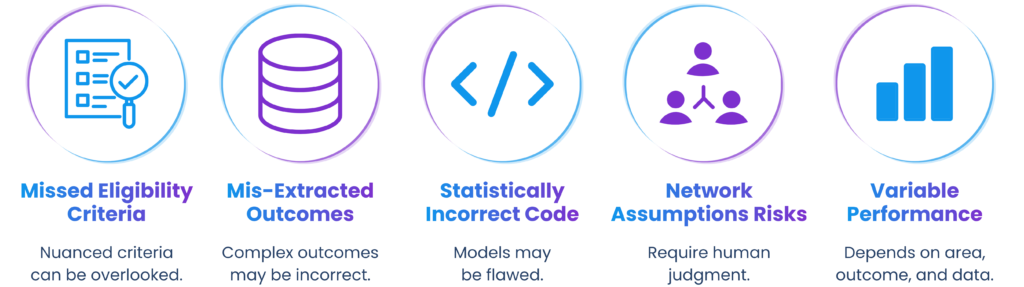
Limits of AI-Native Evidence Generation
AI-Native systems can still miss nuanced eligibility criteria, mis-extract complex outcomes, or generate statistically incorrect code when prompts or training data are insufficient. Network geometry assumptions (transitivity, consistency) remain human judgments. Over-automation without validation introduces risk of systematic error.
Mitigation requires rigorous pre-deployment testing, continuous monitoring against human baselines, and mandatory expert review of model diagnostics and final rankings. Transparency about limitations in the published report preserves scientific integrity.
Performance varies by therapeutic area, outcome type, and data quality. Sparse networks and rare events remain challenging for both traditional and AI-assisted approaches.
Trends in Comparative Evidence
Living network meta-analyses will become more common as continuous monitoring and incremental updates lower the cost of currency. Multi-modal agents will extract data from figures and supplementary tables more reliably. Standardization of evaluation frameworks will improve comparability across tools.
Closer coupling between systematic review platforms, risk-of-bias modules, and statistical engines will create end-to-end comparative evidence factories. Organizations that combine technology with strong governance will deliver the timely, defensible comparisons that payers, regulators, and clinicians require.
Final Thoughts
AI-Native Network Meta-Analysis does not replace statistical expertise. Instead, it amplifies that expertise by handling scale, repetition, and code generation while leaving assumption checking and interpretation to trained scientists. For teams responsible for comparative evidence, the practical question is how quickly and carefully the organization can adopt architectures that combine automation with rigorous oversight.
Platforms purpose-built as a Life science solution and MadeAi demonstrate that integrated literature synthesis and statistical modeling are already achievable. Organizations that begin with focused use cases, measure both speed and fidelity, and maintain transparent governance will convert growing evidence volumes into strategic comparative insights.
Review current NMA bottlenecks, identify high-volume treatment landscapes, and pilot an AI-Native approach under controlled conditions with clear human-in-charge checkpoints. The next generation of comparative evidence will belong to teams that treat synthesis as a continuous, auditable, and expert-guided process.
Author’s Note: This article was supported by AI-based research and writing, with Claude 5 assisting in the creation of text and images.