

 Meghan Oates-Zalesky
Today’s Reality vs. Future of Medical Affairs
Imagine a seasoned oncologist in her clinic, preparing for morning rounds. Two decades ago, understanding the safety profile of a novel compound often meant waiting for a Medical Science Liaison (MSL) to deliver a curated slide deck. The MSL acted as a highly credible, yet fundamentally transactional, data courier.
By 2026, that same oncologist accesses PubMed, UpToDate, real-world cohort studies, and AI-synthesized literature summaries in moments, before her coffee cools. The old “information gap” has collapsed. What remains is a more challenging interpretation gap.
Healthcare professionals now drown in data, with many spending significant time on administrative and data-related tasks (often cited at around 30-40% or more in various studies). They no longer need more raw information; they need clear signals extracted from noise and contextualized to their specific patient populations.
This shift marks a profound evolution of AI in Medical Affairs, that is, from a function focused on scientific information dissemination to an intelligent nerve center for generating and interpreting strategic insights. Powered by large language models (LLMs), agentic AI, and mature real-world evidence (RWE) pipelines, this transformation highlights how deep tech rewires healthcare workflows. Let’s explore the engineering and operational changes driving this change.
AI in Medical Affairs and Intelligent Insight Pipelines
It is easy to dismiss the current AI wave as just another cycle of enterprise software hype, but the data tells a different story. In 2026, the generative AI market in healthcare is projected to reach $53.7 billion by 2035, growing at a 35.1% compound annual growth rate. An impressive 63% of healthcare and life sciences professionals are actively using AI. But the real story isn’t just widespread adoption. It is what is being adopted.
Generative AI and LLMs are driving Medical Affairs transformation, now emerging as the primary compute workload for life sciences organizations—cited by 69% of surveyed professionals. More significantly, the rapid scaling of Agentic AI systems engineered not just to generate text, but to execute independent, multi-step reasoning. Currently, 47% of organizations are using or assessing agentic AI platforms.
To understand why this matters, consider the difference between traditional search and autonomous reasoning. If a legacy system is like a sophisticated index, an agentic AI is like an autonomous research assistant. Instead of simply aggregating clinical trial results, these AI-native insight pipelines synthesize literature, trial data, and real-world intelligence at speeds impossible for human teams. The following diagram illustrates the transition from data ingestion to human action.
Transition from Raw Data to Actionable Insight:
- Data Ingestion Layer: Ingests unstructured text (medical literature, physician notes, conference transcripts) and structured data (EHRs, wearables, claims).
- AI Reasoning Layer: Performs semantic extraction, pattern recognition, and multi-step querying using agentic AI.
- Output/Interpretation Layer: Delivers synthesized dashboards that empower MSLs to formulate localized clinical strategies.
As the Medical Affairs Professional Society (MAPS) emphasizes in its work on insights management and agentic AI, organizations are moving beyond merely “collecting” observations to actively using data to “drive strategy.” Insights now live in dynamic, real-time interpretation rather than static slide decks
Architecture of Insight-Led Medical Affairs
To declare an organization “AI-powered” is practically meaningless without defining the architecture. Achieving an insight-led Medical Affairs solution requires a robust, interconnected, three-tiered technology stack:
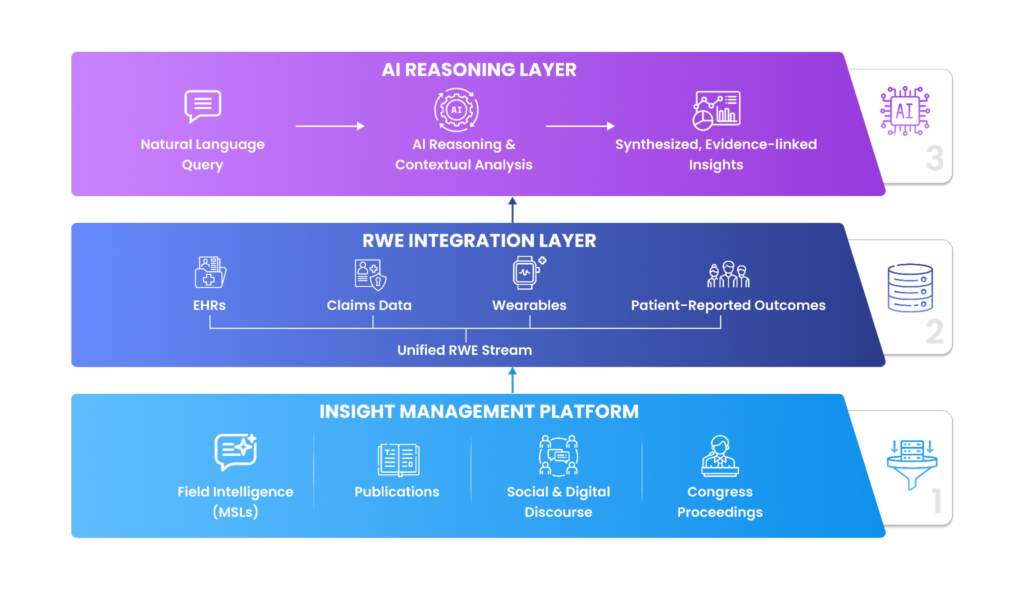 From fragmented data to evidence-linked Medical Affairs insights
- Insight Management Platform. This foundational layer captures and analyzes field intelligence from MSLs, merging it with external signals such as peer-reviewed publications, social media discourse, and congress proceedings. NLP engines parse unstructured data to identify emerging trends and sentiment shifts in real time.
- Real-World Evidence (RWE) Integration Layer. Traditional clinical trials, while essential, often fall short for modern decision-making involving complex patients. This layer integrates EHRs, claims databases, and wearable data into a unified environment. It turns RWE into a continuous intelligence feed rather than periodic projects. AstraZeneca, for example, has repositioned evidence generation toward proactive strategic capabilities, incorporating health economics, predictive analytics, and patient-reported outcomes.
- AI Reasoning Layer. This pinnacle enables contextual, complex querying. An MSL might ask: “What are the most common reasons oncologists in the northeast are deprioritizing this regimen in second-line settings, and how does this compare to the latest RWE?” The system responds with synthesized, evidence-linked answers rather than raw dumps.
Structural Transformation: The Old Model vs. The New Model
Technological implementation requires operational realignment. The table below compares the legacy Medical Affairs approach with the insight-led model emerging in 2026 and beyond:
| Dimension | Traditional Medical Affairs | Insight-Led Medical Affairs (2026+) |
|---|---|---|
| Primary Purpose | Scientific information dissemination to HCPs. | Insight generation, contextual interpretation, and strategic influence. |
| Evidence Base | Highly controlled clinical trial data, approved label information. | RWE, patient-reported outcomes, EHR analytics, and AI-synthesized literature. |
| Technology Role | Legacy CRM for interaction logging, basic slide library management. | AI insight platforms, NLP engines, continuous RWE analytics, and omnichannel tools. |
| MSL Core Skill | Scientific knowledge depth, compliance fluency. | Data literacy, strategic advisory, multi-layered contextual interpretation. |
| Success Metrics | Volume-based: Number of interactions, reach, exchange logs. | Outcome-based: Insight quality, strategic influence, patient outcomes. |
| Regulatory Posture | Compliance-first, strict risk mitigation focus. | Proactive evidence governance, responsible/ethical AI frameworks. |
What becomes immediately apparent from this comparison is that while platforms like agentic AI and RWE pipelines enable the shift, the true hurdle is cultural. Medical Affairs must pivot from an identity built around “what we know” to a mandate of “what we help others understand and act upon”.
The Human Dimension: What AI Cannot Replace
The rise of generative AI brings risks like “shadow AI”—unsanctioned use without oversight, which can lead to compliance or patient safety issues. Leading organizations counter this with responsible AI frameworks ensuring insights are traceable, explainable, and aligned with FDA and EMA guidelines.
AI excels at pattern detection, such as spotting regional prescribing variations outside approved labels. However, it struggles with nuanced context: Is this a genuine unmet need, a safety signal, or a data artifact? Human clinical judgment, real-world experience, and trusted relationships remain irreplaceable.
In this environment, the modern MSL uses AI for data aggregation and pattern recognition, freeing time for higher-value work: strategic insight, scientific exchange, and relationship-building. Human trust and judgment gain value, not diminish.
Conclusion: The Mandate for 2026 and Beyond
The transformation of Medical Affairs from information delivery to insight interpretation is not a future hypothesis; it is the current operational reality. The convergence of Agentic AI platforms, real-world evidence maturity, and strategic human competencies has turned Medical Affairs into a genuine engine of competitive differentiation.
As we look to the remainder of the decade, the imperatives for technology leaders and biopharma executives are clear:
- Redefine your metrics: You cannot measure a deep-tech, insight-led organization using legacy, volume-based KPIs. Prioritize outcome-oriented metrics like insight, actionability, and patient impact.
- Mandate data literacy: Ensure that teams operating in the field understand the statistical limitations of the data they are presenting. An AI output is only as valuable as the human interpreting it.
- Build governance alongside capability: Do not deploy autonomous reasoning tools without the ethical frameworks required to keep them compliant, traceable, and unbiased.
Technology has automated information delivery. Strategy, interpretation, and responsibility for human health remain human endeavors. The central question in 2026 is not whether organizations can deploy advanced AI, but whether their culture and operations are ready to harness it effectively.
Are you merely generating data, or are you engineering true insight?
Author’s Note: This article was supported by AI-based research and writing, with Claude 4.6 assisting in the creation of text and images.