
Achievement recognizes organizations, products, teams, and individuals delivering measurable results through artificial intelligence
CAMBRIDGE, April 9, 2026—MadeAi, Inc. (MadeAi) today announced it has been named a winner in the 2026 Artificial Intelligence Excellence Awards, in the Generative AI category supporting life sciences. Presented by the Business Intelligence Group, the award recognizes organizations, products, teams, and…
Imagine a world where drug safety isn’t just about responding to problems after they occur, but it’s about predicting and preventing them before patients are at risk. For decades, traditional pharmacovigilance (PV) has functioned like a fire alarm system: it activates only once the smoke appears. Adverse drug reactions (ADRs) are collected through Individual Case…
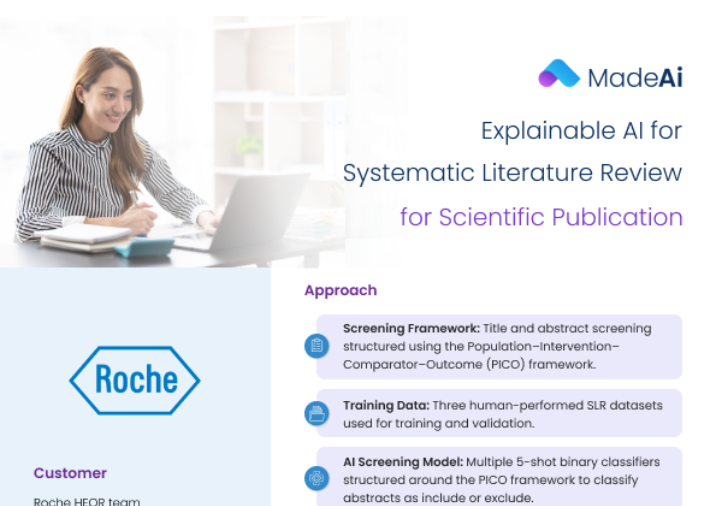
How do you screen thousands of abstracts with transparency and reproducibility using minimal training data? In this case study, MadeAi partnered with the Roche HEOR team to design and validate an explainable AI pipeline for title and abstract screening in a systematic literature review. Using a structured PICO-based framework, the team screened over 3,300 abstracts…
For years, the pharmaceutical industry has followed a familiar cycle: design a clinical trial, execute it, lock the database, analyze the results, and then wait for the next study to answer remaining questions. Wait for post-market surveillance to show real-world outcomes. Wait for regulators or payers to request more data before approving reimbursement. However, this…
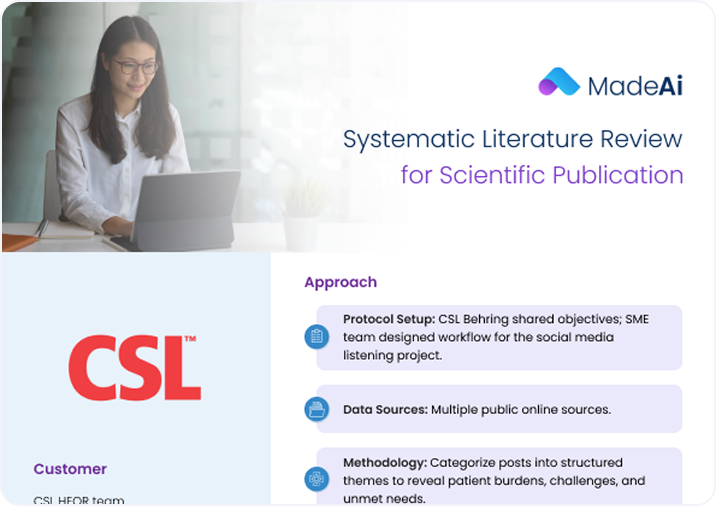
How do you turn unstructured social media conversations into publication-ready evidence in just 4 weeks? In this case study, MadeAi partnered with the CSL HEOR team to identify and curate hereditary angioedema-related conversations from public online sources, with insights supporting a Value in Health Journal article. Using a structured social media listening approach, the team analyzed 3,069 records to…
The pharmaceutical industry is currently at a pivotal moment in the AI landscape. After years of cautious AI experimentation limited to isolated labs and pilot programs, something fundamentally different is unfolding in 2026. The central question has shifted from “Does AI work?” to “How do we deploy it safely and at scale?” especially in organizations…