

 Meghan Oates-Zalesky
Why the Industry is Testing the Wrong Thing
The life sciences industry faces a growing paradox: organizations are investing heavily in AI, yet many evaluation methods fail to measure how these systems actually perform in real-world evidence synthesis workflows. Every week, new evaluations emerge, and task forces publish guidelines. Academic papers rank AI tools. Organizations study these assessments carefully before deciding whether to invest. And yet, something’s deeply wrong with how we’re measuring success.
The real issue? Most evaluations test AI as if it were a simple prompt-response tool. One question. One answer. Measure. Conclude. In reality, the AI systems deployed in evidence synthesis bear almost no resemblance to this model.
When a serious research team uses AI, they don’t just type a question and trust the response. Instead, they’ve built an entire ecosystem around the technology—structured inputs, refined workflows, validation checkpoints, and human expertise at critical junctures. The AI performs within that system, not in isolation.
Yet the evaluations ignore this. And the consequences are significant: promising systems get overlooked, weak tools get overvalued, and adoption stalls based on incomplete evidence.
Why Current AI Evaluations Miss the Mark
What’s Being Tested Today
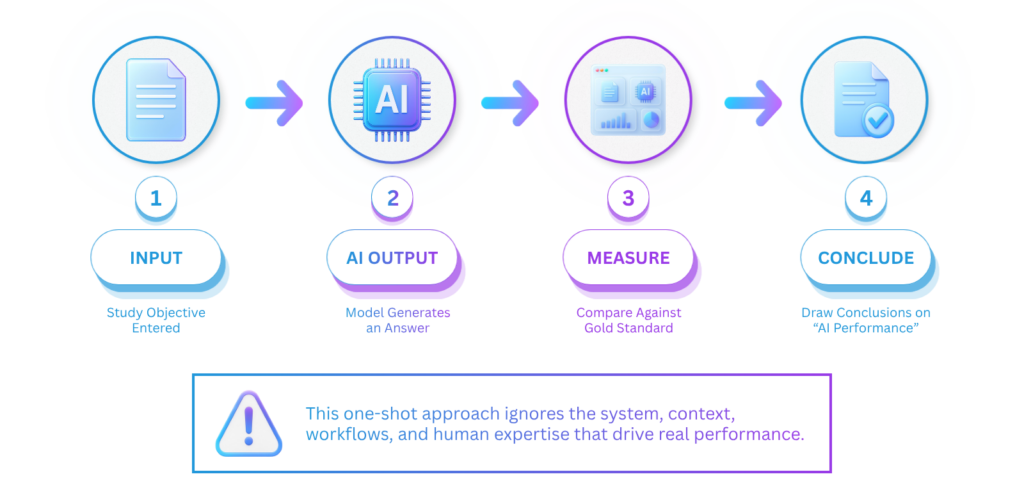
One-Shot AI Evaluation: Measuring Outputs Without Real-World Context
Most AI evaluations follow a predictable pattern: researchers input a study objective into a general-purpose language model, ask it to generate a search strategy or classify abstracts, measure the output against a gold standard, and draw conclusions about “AI performance.” It sounds reasonable in theory. In practice, it’s fundamentally flawed.
Why This Approach Fails
This one-shot model strips away everything that makes AI systems work in practice. Specifically, it ignores the critical elements, from prompt engineering depth and workflow architecture to human-in-the-loop integration and real-world conditions. Each missing element has cascading consequences: poor input design cripples even strong models, a lack of decomposition causes errors to accumulate silently, the absence of human oversight removes domain grounding, and controlled lab conditions fail to predict production performance.
Consider screening abstracts for a systematic review. The one-shot evaluation might present 100 abstracts to an LLM and measure accuracy. But in a real team’s workflow, inclusion criteria are decomposed into structured checkpoints using the PICO framework (Population, Intervention, Comparison, Outcome). Borderline cases get flagged for expert review rather than forced into binary decisions. Team feedback refines the system’s understanding after each batch. Traceability logs connect every decision back to source data. That’s not the same task being tested. That’s a fundamentally different system performing at a different level.
Result? The evaluation concludes “AI screening is inconsistent.” The team’s system outperforms the evaluation’s benchmark by 30%. Everyone loses: the organization misjudges the technology, the vendor can’t address concerns rooted in methodology, and trust erodes.
Why Different AI Approaches Aren’t Interchangeable
Even within a single task, for instance, screening abstracts, there are multiple valid AI methodologies that exist. Relevance ranking uses continuous scoring to measure how closely each abstract matches the inclusion criteria. Tagging and concept clustering group abstracts semantically into thematic buckets for human-filtered classification. Criteria-based classification uses structured decision trees where the model explicitly evaluates each PICO component. Each approach has different strengths and tradeoffs as shown in the comparison below.
| Method | Strength | Tradeoff | Best For |
|---|---|---|---|
| Relevance ranking | Captures uncertainty; prioritizes for human review | Requires threshold tuning; can surface borderline noise | High-recall initial screening |
| Tagging/clustering | Transparent reasoning; good for discovery | Slower; requires semantic model training | Exploratory reviews where patterns are unknown |
| Criteria-based classification | Structured, auditable, rule-aligned | Less flexible; poor at nuance | Regulatory-aligned, narrow inclusion criteria |
Yet many evaluations treat “AI screening” as a monolith (i.e., no differentiation between methods, no acknowledgment of tradeoffs, no context for which approach suits which scenario).
This is like asking “Is surgery effective?” without distinguishing between cardiac surgery and dental work. The answer depends entirely on the problem being solved.
The Expertise Gap: Who’s Actually Defining AI Standards?
Here’s an uncomfortable truth: Many of the entities guiding AI evaluation in evidence synthesis are not deeply experienced in building or deploying AI systems.
They’re experts in evidence synthesis. They understand systematic reviews, meta-analysis, regulatory pathways, and clinical decision-making intimately, and this expertise is essential. Expertise in clinical trial design does not automatically translate to expertise in AI systems. Understanding how models behave, how workflow architecture affects outputs, and how to design for traceability and error resilience requires specialized AI knowledge.
This creates a blind spot where evaluators conflate what AI looks like in theory (a single model making predictions) with what AI can achieve in practice (a system with human oversight, workflow decomposition, and iterative refinement). The gap between these two perspectives is where the problems hide.
The Risk to the Market
These flawed evaluations are already shaping critical decisions. Organizations exclude high-performing systems based on incomplete evaluation criteria. Teams delay deployment when assessments suggest “AI isn’t ready,” even though the systems are production-ready. Companies pour resources into addressing evaluation concerns that don’t reflect real-world usage. Policymakers develop guidance based on what evaluations claim is possible rather than what’s actually deployable. The industry needs better assessment frameworks, and it needs them urgently.
A Higher Bar: What Credible AI Evaluation Looks Like
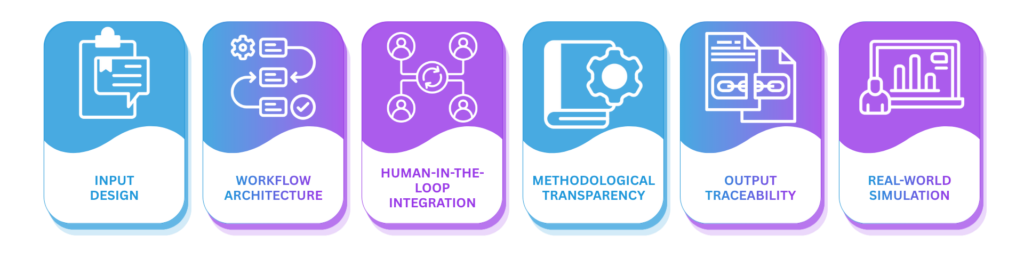
Six Dimensions for Trustworthy and Reliable AI in Evidence Synthesis
If the goal is to assess AI in evidence synthesis meaningfully, evaluations must address six core dimensions.
Input design must ensure inputs are structured (PICO, JSON schemas, validation rules) and prompt engineering is iterative and contextualized rather than one-shot and generic—because a well-architected input layer can overcome model limitations while a poor input layer will cripple even strong models.
Workflow architecture requires that tasks be decomposed into logical steps with intermediate validation, allowing outputs at each step to be inspected and corrected before feeding into the next. This matters because decomposition surfaces errors early while integrated workflows accumulate errors silently.
Human-in-the-loop integration must define where domain experts intervene and how disagreements between the model and human reviewers get resolved, since human oversight prevents cascading errors and grounds decisions in domain knowledge.
Methodological transparency demands that evaluation datasets be representative of real-world data, that evaluations be reproducible with identical methodology, and that all decisions be pre-specified—because reproducibility prevents cherry-picking results and builds confidence in findings.
Output traceability ensures every decision can be audited back to source data and reasoning, with explainable outputs for non-technical stakeholders, a non-negotiable requirement for regulatory compliance and trust.
Finally, real-world simulation tests whether the evaluation reflects actual usage conditions (data volume, diversity, noise, time constraints) and whether batch processing, edge cases, and error recovery are tested, because lab performance often fails to predict production performance.
The Path Ahead: Rigor and Accountability
The life sciences sector has long demanded the highest standards for evidence generation. AI deserves the same or more, given its complexity and the stakes involved.
Initiatives like the Responsible AI in Evidence Synthesis (RAISE) guidelines and joint positions from Cochrane, Campbell Collaboration, JBI, and others are pushing for better practices, including transparent reporting, ethical considerations, and practical validation.
The future belongs to organizations that evaluate and implement AI with rigor and precision. It will go to those who evaluate and implement it with depth and precision.
Closing Thoughts
AI isn’t failing evidence synthesis. Our evaluation frameworks are failing to capture their true potential. By shifting focus from isolated prompts to complete systems, and insisting on rigorous, transparent assessments, we can unlock faster, higher-quality evidence synthesis without compromising trust.
Let’s measure correctly so we can move forward confidently.
Author’s Note: This article was supported by AI-based research and writing, with Claude 4.5 assisting in the creation of text and images.