

 Angeline Dhas
AI-augmented literature reviews are transforming evidence generation across life sciences. This blog explores multi-project analysis of AI-assisted literature reviews. It examines improvements in review speed, screening accuracy, traceability, and workflow efficiency while maintaining rigorous human oversight for submission-ready outcomes.
For teams in health economics and outcomes research (HEOR), regulatory affairs, and evidence generation, systematic literature reviews (SLRs) are essential. However, they are often resource-intensive and difficult to manage. Data volumes grow, and timelines tighten for Clinical Evaluation Reports (CERs) and Periodic Safety Update Reports (PSURs). Due to this, traditional manual workflows struggle to keep pace. Reviewer fatigue, variability, and lengthy quality control cycles add pressure, especially when submissions demand full transparency and reproducibility.
At ISPOR 2026, MadeAi presented insightful findings from a multi-project study that tested a next-generation AI-augmented framework in real regulatory settings. The results show how structured AI integration can transform literature review workflows without compromising the rigor required for submission-grade work.
The Real-World Challenge in Regulatory Literature Reviews
Manual literature reviews have long been the standard, but they come with clear limitations. Traditional reviews involve protocol development, database searches, Excel-based deduplication, screening, full-text retrieval, data extraction, and PRISMA reporting. Each step is time-consuming and resource-intensive.
Even experienced teams face scalability issues. When record volumes jump from dozens to thousands, hours pile up quickly, increasing costs and delaying critical submissions. Moreover, maintaining consistency and audit-ready documentation across projects becomes increasingly complex.
To tackle these challenges, MadeAi developed and evaluated a standardized AI-augmented framework for Literature Review designed specifically for regulatory-grade evidence synthesis. The goal was not just faster reviews, but defensible, transparent processes that regulators can trust.
Study Design: Comparing Manual and AI-Augmented Literature Review
The research team compared five real-world regulatory literature review projects supporting CERs and PSURs.
Project 1 was conducted using a traditional, fully manual review process and served as the baseline for comparison. Projects 2–5 leveraged the MadeAi platform’s AI-augmented workflow to evaluate the impact of AI on review efficiency, quality, and overall workflow performance.
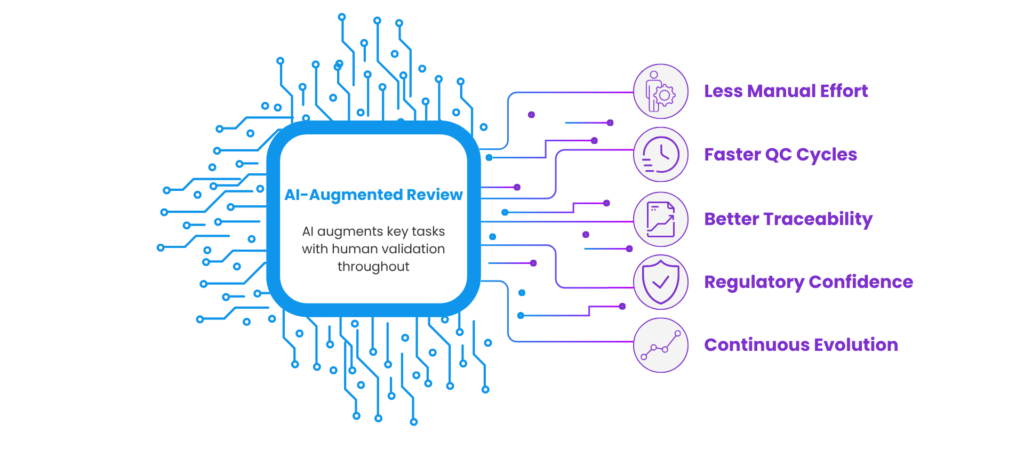
Efficiency of an AI-augmented literature review workflow
All projects followed the same core process: protocol development, literature search, deduplication, title/abstract screening, full-text screening, data extraction and appraisal, evidence table creation, and PRISMA reporting. The AI-augmented projects integrated AI throughout the workflow. Human reviewers retained responsibility for adjudication, validation, and quality oversight at every stage.
This hybrid approach ensured that AI handled repetitive, high-volume tasks while humans focused on medical judgment, conflict resolution, and final interpretation.
Key Results of AI-Augmented Literature Review: Speed, Accuracy, and Scalability
The findings were phenomenal and showed clear progression as teams matured in their use of the AI framework.
Time Savings: Early AI adoption delivered 17–33% time savings. As workflows matured, savings reached up to 55%, even as article volumes scaled dramatically from 120 records in the manual project to 2,300 in later ones.
AI Accuracy: Consistently high at 84–90% across screening and data extraction stages, with human validation ensuring regulatory-grade outputs.
Efficiency Highlights: The solution significantly reduced manual effort across screening, deduplication, data extraction, and evidence table development. As a result, review completion became much faster. It also shortened quality control cycles through standardized, AI-assisted workflows. Automated PRISMA flowchart generation and comprehensive audit-ready documentation further improved traceability.
Scalability. The AI-augmented approach handled nearly 19 times more articles than the manual baseline while delivering substantially better hours-per-article efficiency.
AI-Augmented Literature Review – Performance Summary of Projects
| Project Type | Total Volume | AI Accuracy | Human Hours | Time Savings |
|---|---|---|---|---|
| Manual (Baseline) | 120 | N/A | 71 | 0% |
| During AI Adoption | 265–130 | 88–90% | 130–60 | 17–22% |
| Mature AI Adoption | 2,300–800 | 89–86% | 610–290 | 55–39% |
These results demonstrate that AI does not simply speed things up, but also enables sustainable, scalable workflows that maintain methodological rigor.
Connecting the Research to Client Value
For pharmaceutical companies, medical device manufacturers, and HEOR teams preparing regulatory submissions, these findings translate into meaningful advantages.
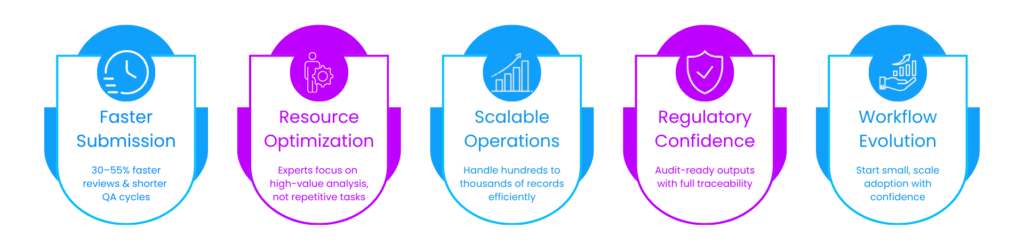
Key advantages of AI-augmented literature reviews for regulatory submissions
Faster Time-to-Submission: Reducing review timelines by 30–55% can accelerate CERs, PSURs, and other deliverables, helping teams meet tight regulatory deadlines and bring evidence to market faster.
Cost Efficiency and Resource Optimization: Significant reductions in human hours free up skilled reviewers for higher-value interpretation and strategy work rather than repetitive tasks. This leads to better team morale and more predictable project budgeting.
Scalability for Growing Evidence Needs: Whether handling small targeted reviews or massive database searches with thousands of records, the framework adapts without proportional increases in time or cost.
Regulatory Confidence and Defensibility: Consistent AI accuracy, human oversight, and enhanced traceability make outputs audit-ready. They also support regulatory expectations for transparency and reproducibility.
Improved Workflow Evolution: Organizations can start with pilot projects and gradually mature their AI adoption, seeing compounding benefits over time as processes refine.
This multi-project analysis demonstrates that AI, when implemented within structured and governed frameworks, is ready to support evidence generation in regulated environments. AI does not replace human expertise. Instead, it improves efficiency, consistency, and decision-making while experts retain oversight and accountability.
Looking Ahead: The Future of Submission-Grade Evidence Generation
This ISPOR 2026 research marks an important step toward broader, responsible adoption of AI-augmented Literature Review in regulatory evidence workflows. As literature volumes continue to expand, structured frameworks like this one will be key to maintaining efficiency without sacrificing quality or compliance.
For evidence generation leaders, the takeaway is clear: AI-augmented literature reviews are no longer experimental, they are becoming a strategic advantage for faster, more scalable, and defensible outputs.
The evolution shown across these five projects offers a practical roadmap for organizations ready to modernize their SLR processes.
Author’s Note: This article was supported by AI-based research and writing, with Claude 4.5 assisting in the creation of text and images.