


 Meghan Oates-Zalesky
If Prediction #1 marked AI’s move into the core of life sciences operations, Prediction #2 defines how that AI will operate: not as passive copilots, but as agentic systems that reason, plan, and execute work autonomously.
In CapeStart & MadeAi’s 2026 Predictions for AI in Life Sciences webinar, Angeline Dhas, Head of Product Management for MadeAi, and Siva Karthick, Machine Learning Lead for MadeAi, highlighted what may be the most important operating-model shift of the decade: 2026 will be the year agentic AI becomes the dominant paradigm across life sciences workflows.
From Suggestion to Execution
Until recently, most AI systems in life sciences functioned as assistants, tools that suggested literature, summarized studies, or helped draft outputs. Agentic AI goes a step further.
These systems don’t just respond to prompts; they:
- Define goals
- Plan multi-step workflows
- Execute tasks across tools and data sources
- Iterate based on outcomes
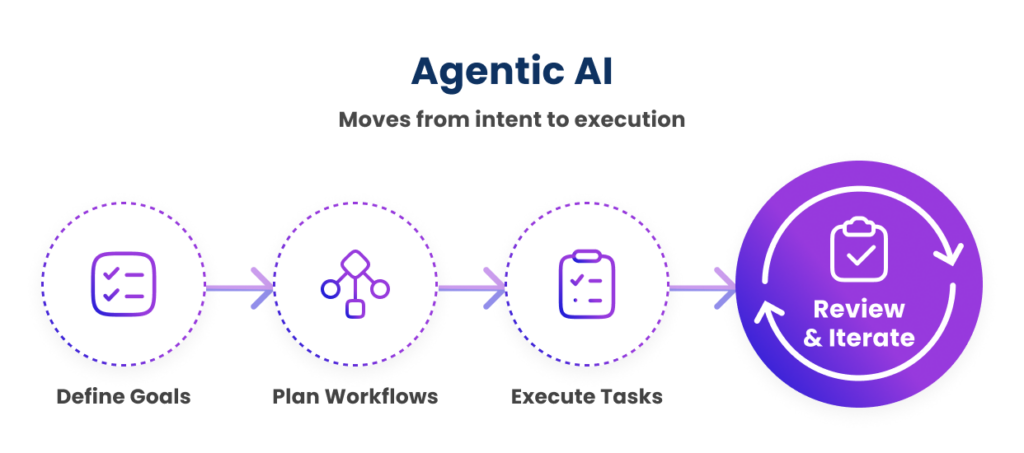 Agentic AI: Moving from intent to execution
In short, they move from conversation to action.
This shift is already underway. Early browser-based agents have evolved into desktop and enterprise operators that can read, edit, generate, and orchestrate multi-step tasks with minimal human input. The leap from fluent text generation to structured problem-solving and workflow execution is what makes agentic AI transformative.
A New Model for R&D and Evidence Generation
In life sciences, the implications are profound. Agentic AI systems are beginning to:
- Generate novel research hypotheses
- Design and refine experimental protocols
- Conduct major aspects of the literature review process with minimal human review
- Extract and structure data across hundreds of variables
- Optimize workflows across regulatory, HEOR, and market access teams
Emerging platforms, like Variant Bio’s Inference engine, are already demonstrating how AI can accelerate discovery with minimal human direction, compressing timelines that once took months into weeks.
For evidence generation teams, this means AI is no longer just accelerating tasks. It owns entire workflow segments.
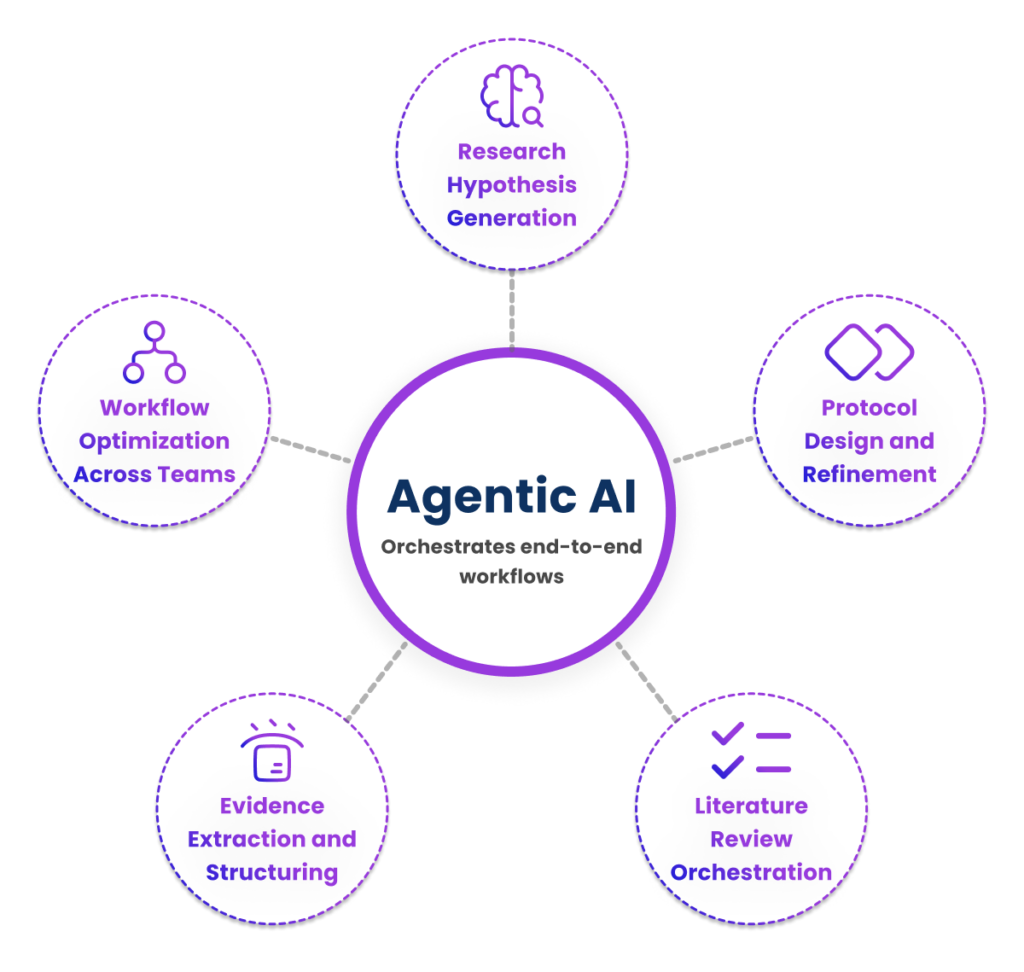 Agentic AI across the end-to-end evidence workflow in life sciences
The Impact on Operating Models and Talent
This evolution will reshape how organizations in life sciences structure their teams. Senior leaders are already recognizing that routine, repeatable tasks—often handled by junior roles—are the first to be automated by agentic systems. But this is not simply a story of replacement.
Instead, it is a shift in how work is performed:
- Junior roles evolve into AI supervisors and validators
- Senior experts focus on interpretation, strategy, and decision-making
- Teams become smaller but more productive, supported by AI agents operating continuously in the background
The result is a new human + agent operating model in which AI executes, and humans govern, validate, and guide.
Why this Matters for Regulatory-Grade Work
In life sciences, autonomy must be paired with trust, traceability, and compliance.
For agentic AI to be viable in regulatory and HTA workflows, it must:
- Maintain full audit trails
- Provide source traceability
- Enable human-in-the-loop checkpoints
- Deliver consistent, reproducible outputs
This is where the next generation of enterprise-grade platforms, like MadeAi, are focused: combining agentic automation with governance frameworks that meet regulatory expectations.
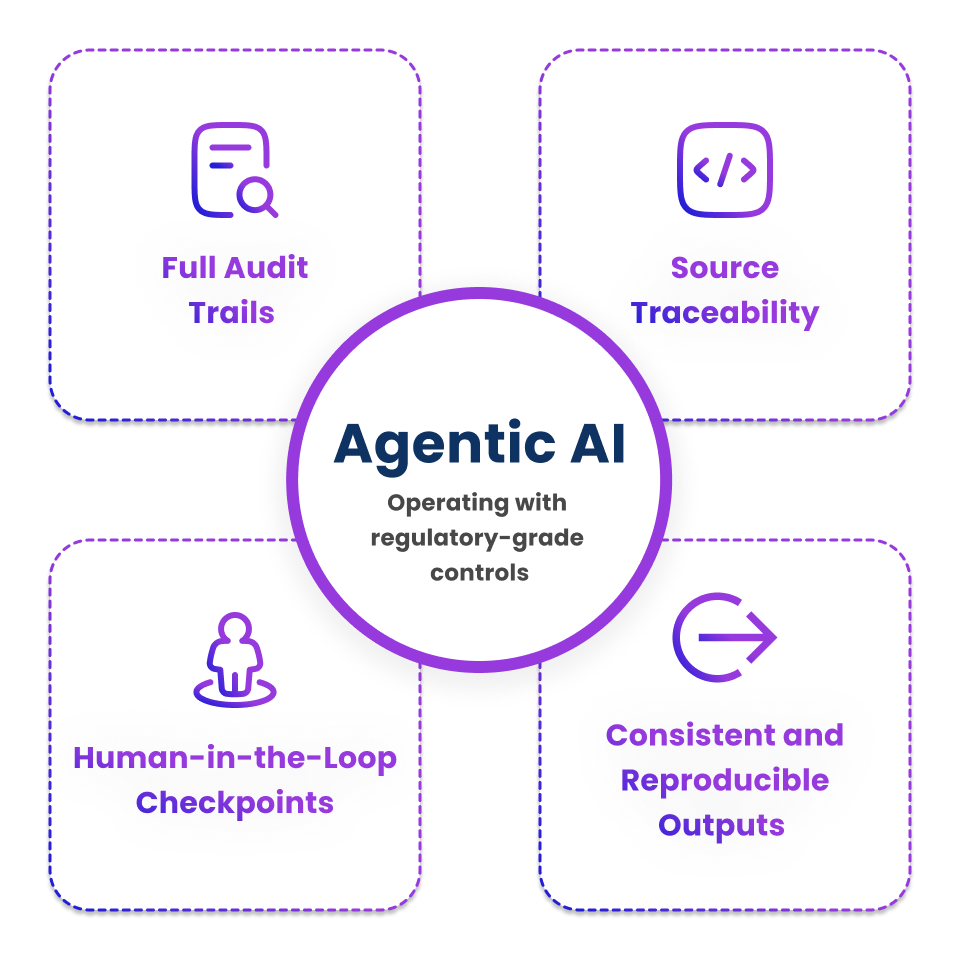 How MadeAi enables agentic AI with regulatory-grade controls
MadeAi’s architecture is already aligned with the agentic future. Within the platform, AI agents can:
- Orchestrate end-to-end literature reviews
- Execute multi-level screening and ARM-level extraction
- Perform risk-of-bias assessments
- Generate structured summaries and submission-ready outputs
All while maintaining the traceability, methodological rigor, and human oversight required for HTA, GVD, and regulatory submissions.
This enables organizations to move beyond isolated automation toward fully orchestrated, AI-driven evidence pipelines.
The Bottom Line: AI That Acts, Not Just Assists
In 2025, the concept of agentic AI was introduced. 2026 will be the year it scales.
For life sciences organizations, the question is no longer whether to adopt AI. But whether they are ready to adopt AI that acts.
Those who embrace agentic systems will unlock:
- Faster discovery cycles
- More efficient evidence generation
- Lower operational costs
- Greater strategic agility
Those who delay risk falling behind in a world where execution speed is becoming the ultimate competitive advantage.
If you missed the 2026 Predictions for AI in Life Sciences webinar, check it out here.
Author’s Note: This article was supported by AI-based research and writing, with ChatGPT 5.3 assisting in creating text and images.