


If you’ve ever asked ChatGPT to debug code or seen an AI generate a stunning image from a single sentence, you’ve probably wondered, How on earth did we get here so fast?
The reality is, it wasn’t fast at all. It took 75 years of quiet breakthroughs, significant setbacks, and bursts of progress. Here’s the full story, presented in chronological order, highlighting every important moment and each milestone from the AI Innovation Milestone roadmap.
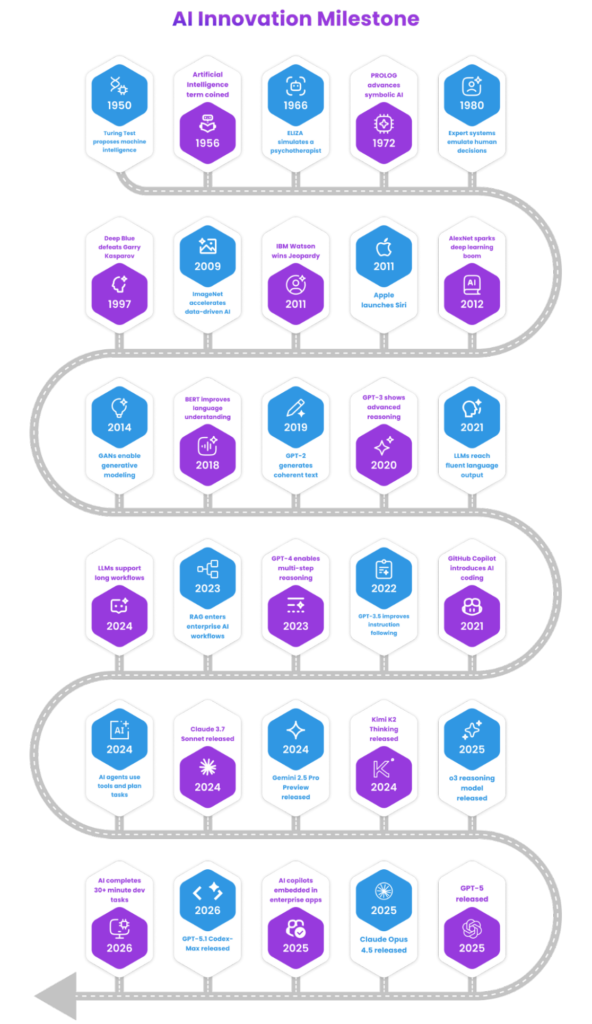
The Evolution of AI: From the Turing Test to Agentic AI
The AI Dream Takes Shape (1950s–1960s)
Everything begins with one bold question in 1950: Can machines think? Alan Turing proposed the Turing Test, a simple way to measure machine intelligence by seeing if it could convince a human that it was another person. That same year, Claude Shannon, a pioneering mathematician known as “the father of information theory” and future namesake for Claude.ai, wrote the first paper on computer chess.
Six years later, in the summer of 1956, a small group of visionaries gathered at Dartmouth College. John McCarthy coined the term “artificial intelligence,” and they declared that every aspect of learning or intelligence could be simulated by a machine. The field was officially started then.
Researchers quickly built the first building blocks of machine learning. Frank Rosenblatt’s Perceptron in 1958 became an early artificial neural network, which is the prototype for the deep learning systems that would dominate decades later.
Symbolic AI and Early Showcases
The early decades were an era of optimism and Good Old-Fashioned AI (GOFAI). The pioneers thought intelligence could be encoded through clear logic and symbols. In 1966, MIT Professor Joseph Weizenbaum developed ELIZA, the world’s first chatbot. It simulated a Rogerian psychotherapist by simply rephrasing users’ statements into questions. To Weizenbaum’s surprise, people attributed human-like feelings to this simple program, revealing our deep psychological readiness to engage with machines.
This period also saw the introduction of PROLOG in 1972, which improved symbolic AI through logic programming.
AI Winters and the Rise of Expert Systems (1970–1990)
Optimism met harsh reality in computing. Hardcoding every rule led to a combinatorial explosion. You can write a rule to recognize a cat, but what if the cat is upside down, hidden by shadow, or drawn as a cartoon?
The Engineering Analogy: Imagine building a modern translation engine by manually writing a dictionary of every single grammatical exception in existence. It becomes fragile and computationally exhaustive.
The 1974 Lighthill report, which offered a pessimistic assessment of AI, triggered severe funding cuts and the first “AI Winter.” A brief thaw arrived in the 1980s with Expert Systems that emulated human decisions in narrow domains, notably DEC’s XCON for configuring computer hardware. But by the late 1980s, the high cost of maintaining these brittle rules triggered a second, deeper winter. The lesson was clear: hardcoding human intelligence does not scale.
The Breakthrough: Machine Learning and the Data-Driven Explosion (1990s–2010s)
The paradigm shift that rescued AI was simple yet profound: stop programming rules manually and instead feed raw data into algorithms so they could discover patterns on their own.
In 1997, IBM’s Deep Blue defeated world chess champion Garry Kasparov, using sheer computing power, evaluating 200 million positions per second. Then came 2009: ImageNet accelerated the data-driven revolution, giving models massive labeled datasets to learn from.
The Deep Learning Boom (2012-2018)
The turning point came in computer vision. In 2012, Geoffrey Hinton’s team unleashed AlexNet at the ImageNet competition. By using deep convolutional neural networks and GPUs, it shattered previous accuracy records.
This breakthrough wasn’t just algorithmic; it was a convergence of three elements:
- The Brain: Multi-layer neural network architectures utilizing backpropagation.
- The Fuel: The internet-scale datasets like ImageNet.
- The Engine: GPUs repurposed for massive parallel matrix math.
From there, the pace quickened:
- 2011: IBM Watson wins Jeopardy!
- 2011: Apple launches Siri
- 2014: Generative Adversarial Networks (GANs) make realistic image creation possible
- 2016: Google DeepMind’s AlphaGo defeats Lee Sedol in Go using reinforcement learning and neural networks to develop an intuition-like strategy even more complex than chess.
The Evolution of AI Architectures
| Epoch | Dominant Architecture | Engineering Philosophy | Key Milestones | Core Limitation |
|---|---|---|---|---|
| 1960s-1980s | Symbolic AI / GOFAI | Explicit logic, “If-Then” rules, Expert Systems | ELIZA, XCON | Inflexible, non-scalable, brittle |
| 1990s-2000s | Early ML & Statistical AI | Pattern recognition driven by algorithms; brute-force search trees | Deep Blue, IBM Watson | Required highly structured data; struggled with nuance and creativity |
| 2010s | Deep Learning (CNNs, RNNs) | Multi-layered artificial neural networks powered by GPUs and Big Data | AlexNet, AlphaGo, Siri, GANs | Highly specialized; lacked a generalized understanding |
| 2017-2023 | Transformers (LLMs) | Self-attention mechanisms predicting probabilistic tokens | GPT2, GPT-3, GPT-3.5, ChatGPT, BERT | Prone to hallucinations; weak multi-step logic |
| 2024-2026 | Agentic & Reasoning AI | Multimodal inputs, RAG, RLHF, tool case | GPT-4, RAG enterprise, o-series, Kimi K2, Claude 3.7 Sonnet, Gemini 2.5 Pro, GPT-5, AI agents | Massive inference computing needs governance |
The Generative Era (2017–2023)
The Transformer architecture presented in Google’s 2017 paper “Attention Is All You Need” changed everything. Self-attention lets models look at an entire sentence simultaneously, instantly mapping contextual relationships between every word.
The Engineering Analogy: Instead of reading a book word-by-word and holding the plot in short-term memory, self-attention lets the model see the whole page at once.
This capability powered BERT (2018), GPT-2 (2019 – coherent text), and GPT-3 (2020 — 175 billion parameters and emergent few-shot learning). By 2021, large language models reached fluent language output, and GitHub Copilot introduced AI-assisted coding to millions of developers.
Then, on November 30, 2022, ChatGPT (GPT-3.5) reached 100 million users in two months. The interface turned AI from APIs designed for specialists into a conversational collaborator, which was the real innovation. GPT-4 in 2023 brought multimodal understanding and advanced reasoning.
The Agentic Era: 2024 to 2026 and Beyond
As we navigate 2026, the tech ecosystem has evolved beyond the novelty of conversational chatbots. The frontier we are currently mapping is defined by Agentic AI, a shift from stateless, prompt-and-response interactions to stateful, autonomous systems capable of executing extended, multi-hour workflows.
From Probabilistic Parrots to Reasoning Engines
The LLMs of 2023 were essentially highly advanced autocorrects; they predicted the next most statistically likely token. While impressive, this architecture had difficulty with rigorous logic and math.
To bridge this gap, 2024 and 2025 saw the commercialization of Reasoning Models such as the OpenAI o-series, Claude Opus series, and Kimi K2. These models simulate “System 2” thinking. Instead of providing an immediate response, they follow hidden chains of thought, breaking complex problems into manageable tasks, testing hypotheses, and correcting errors before responding.
RAG and Multimodal Grounding
The enterprise adoption of AI required solving the “hallucination” problem. Retrieval-Augmented Generation (RAG) solved hallucinations by dynamically pulling proprietary data into the model’s context. Native multimodality now lets AI natively understand text, images, audio, and video.
The Rise of Autonomous Agents
Today’s agents plan, use tools, call APIs, and complete end-to-end tasks, from provisioning cloud infrastructure to resolving complex software bugs. In 2024 alone, we saw:
- LLMs supporting long workflows
- AI agents that use tools and plan tasks
- Claude 3.7 Sonnet, Gemini 2.5 Pro Preview, Kimi K2 Thinking
In 2025, we saw the o3 reasoning model, Claude Opus 4.5, GPT-5, and AI copilots integrated into enterprise applications. By 2026, AI will routinely complete 30+ minute development tasks, with GPT-5.1 Codex-Max pushing the frontier even further.
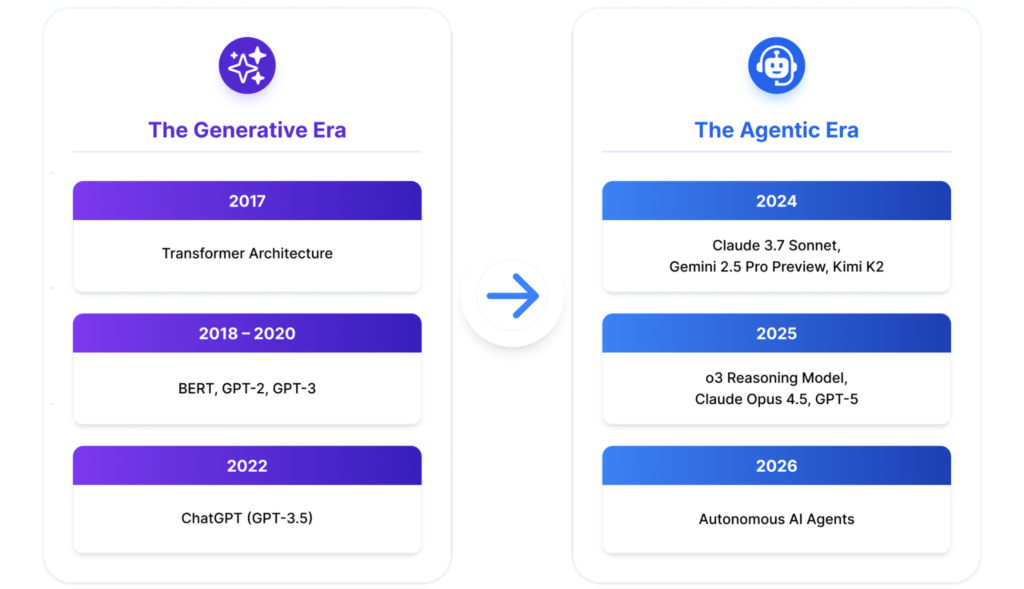 The Generative Era vs. The Agentic Era
Conclusion: Collaboration, Governance, and the Road Ahead
The 75-year journey from the Dartmouth conference to the autonomous agents of 2026 highlights an important truth: managing hype is as critical as managing computing power. As we progress toward AGI, the focus has shifted from raw power to alignment, safety, and governance, addressing black-box opacity, training-data biases, and risks that leaders like Geoffrey Hinton have pointed out.
Key Takeaways for the Deep Tech Architect:
- Data is the Moat, Context is King: Basic computing is becoming a commodity; high-quality domain data and effective RAG pipelines are the real differentiators.
- Embrace Agentic Workflows: Future software will not be statically coded; it will be dynamically managed by AI agents.
- Augmentation over Replacement: Successful cultures will create interfaces that enhance human-AI collaboration.
The history of artificial intelligence reflects human ambition. As we deploy these vast, agentic networks, we are more than just software engineers; we are cognitive architects.
Author’s Note: This article was supported by AI-based research and writing, with Claude 4.6 assisting in the creation of text and image.