


Introduction
Artificial Intelligence is redefining healthcare and life sciences. From improving patient care to accelerating drug discovery, AI is proving to be more than just a technological trend; it’s a critical enabler of innovation and efficiency.
In this article, we explore real-world AI applications in clinical studies, pharmacovigilance, diagnostics, and medical operations. These use cases highlight how AI, when thoughtfully integrated into workflows, can deliver measurable impact, enhance compliance, and provide new scientific insights.
Use Case 1: NLP for Literature Surveillance in Drug Safety
Let’s start with a big challenge we had in drug safety.
The Problem: Imagine our drug safety scientists have to manually review hundreds of literature sources weekly to detect adverse event reports.
Solution:
We decided to automate the process and built a system using natural language processing (NLP) that takes in a daily feed of new literature. The AI reads the articles, picks out key terms, and ranks them by relevance. We included it directly in our team’s workflow with real-time alerts and a complete audit trail.
Impact:
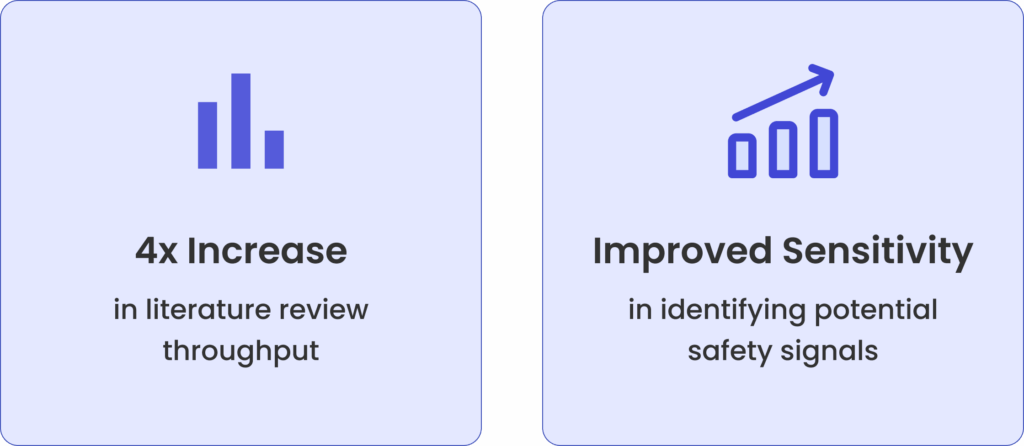
- 4x increase in literature review throughput
- Improved sensitivity in identifying potential safety signals
Design Insight: Model interpretability was built in using SHAP to ensure audit-readiness.
Use Case 2: Automating Pharmacovigilance Case Processing
Next, we tackled the huge amount of paperwork our pharmacovigilance teams were facing.
The Problem: Our safety teams were overwhelmed with manual data entry and triage of Individual Case Safety Reports (ICSRs).
Solution:
We implemented a smart AI workflow to manage it. This system can now take in a new case, automatically assess its severity, and match it to the correct medical terms. It also identifies and flags any duplicate reports. We integrated it directly into our main Argus Safety System.
Impact:
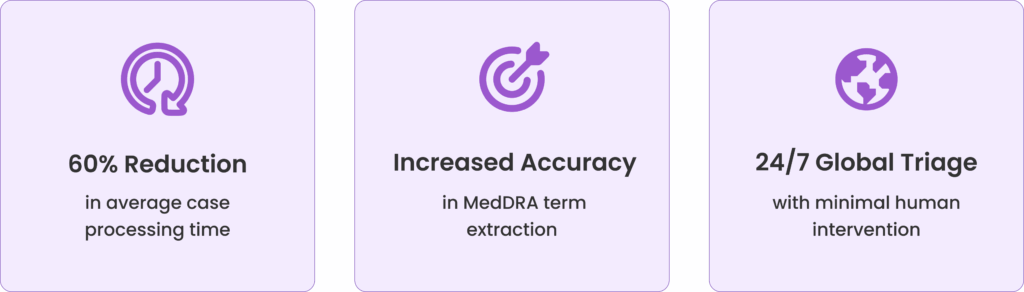
- Attained a 60% reduction in average case processing time
- Achieved increased accuracy in MedDRA term extraction
- Enabled 24/7 global case triage with minimal human intervention
Architecture Note: All AI outputs are reviewed through a human-in-the-loop system for compliance.
Use Case 3: AI-Assisted Systematic Literature Reviews (SLRs) for Clinical Evidence Generation
Anyone who’s worked on a regulatory submission knows how complex the systematic literature reviews (SLRs) are.
The Problem: Conducting systematic literature reviews for regulatory submissions and Health Technology Assessments (HTA) is time-consuming and resource-intensive.
Solution:
We trained models to automatically screen thousands of articles and check if they meet our criteria, and extract the key data points we need. We also created dashboards so everyone can track progress in real-time.
Impact:
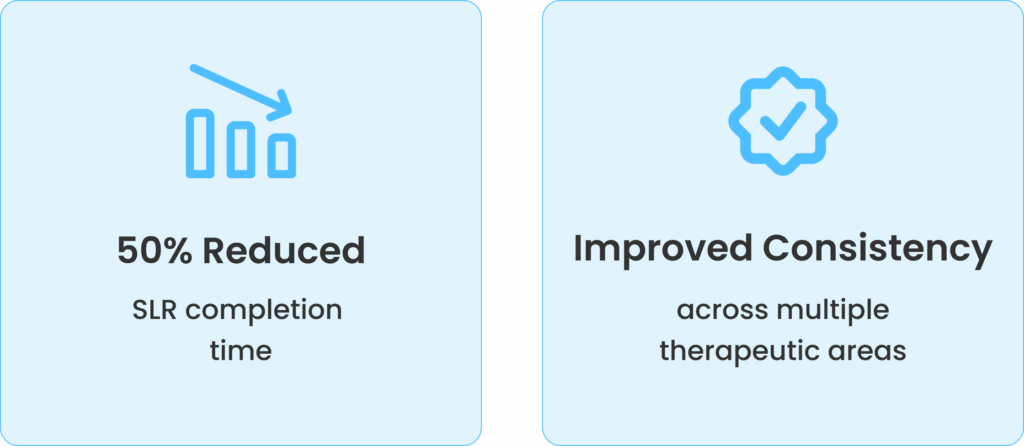
- Reduced SLR completion time by 50%
- Improved consistency across multiple therapeutic areas
Tools Used: DistilBERT, PubMed API, Ray, GRADEpro, custom extraction templates
Use Case 4: Enhancing Clinical Evaluation Reports (CER) for Medical Devices
Finally, our last project was focused on helping the teams that write the crucial Clinical Evaluation Reports for our medical devices.
The Problem: Writing and maintaining Clinical Evaluation Reports (CERs) for CE-marked devices requires frequent updates to the literature and safety information.
Solution:
We set up a powerful AI that can read all the latest information and then generate a first draft of the report’s narrative. The best part is that it works right inside our normal authoring platforms, so our writers and reviewers collaborate on the drafts in real-time.
Impact:
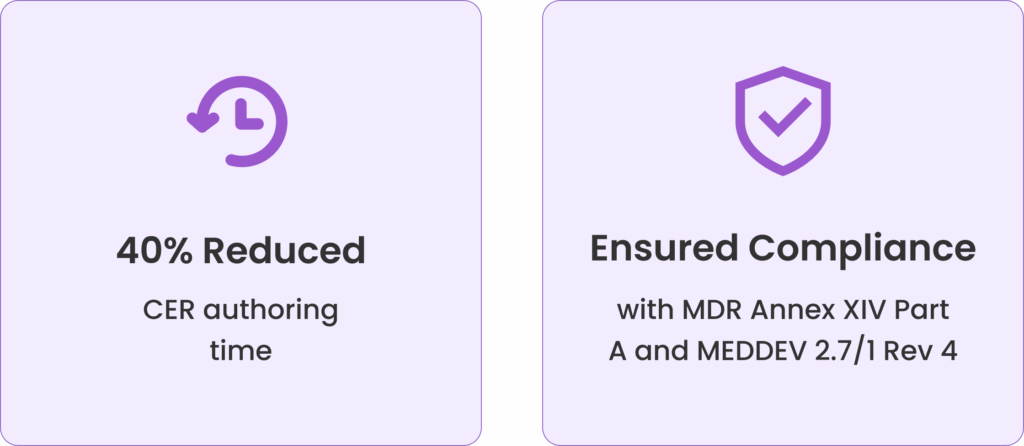
- Reduced CER authoring time by 40%
- Ensured compliance with MDR Annex XIV Part A and MEDDEV 2.7/1 Rev 4
Architecture: GPT-4, Hugging Face Pipelines, Azure Cognitive Search, SharePoint API, DocuSign workflow integration
Best Practices for Scaling AI in Regulated Healthcare Settings
If you’re thinking about bringing AI to solve your problem, here are a few things we’ve learned that are essential.
- Involve Compliance Early: You should align privacy and regulations, and privacy alignment must start at the design phase.
- Human-in-the-Loop is Essential for pharmacovigilance, CERs, and SLRs.
- Explainability: Model interpretation tools are important to support trust and audit-readiness.
- Data Provenance & Versioning: You need to ensure traceability from raw data to the decision.
- Cross-Functional Collaboration: Combine clinical, data science, regulatory, and quality expertise through collaboration.
Conclusion
AI is significantly changing healthcare and the life sciences, from producing compliant clinical evidence to optimizing safety workflows. These use cases demonstrate that selecting the appropriate problems, creating traceable and compliant systems, and integrating AI into high-value workflows are all necessary for success.
As the industry embraces AI for efficiency and scientific rigor, its role in regulatory excellence, patient safety, and clinical innovation will only grow.